
Starbucks Union Contract Negotiations: A Race Against Time
Starbucks Workers United (SBWU) has won elections at over 250 stores in more than a year, representing about 6,500 workers, but first-contract negotiations have stalled over issues such as Zoom participation and bad-faith bargaining allegations. With the decertification window about to open, the union faces structural challenges including time urgency, staff turnover, and financial disadvantages.
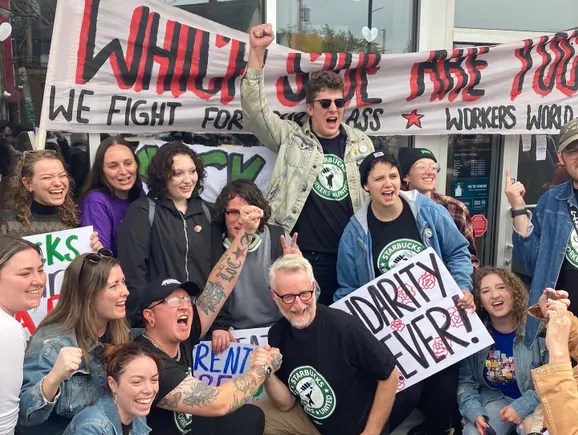
This week marks one year since ballots were cast in Starbucks' first union election. Since then, what began as a grassroots movement involving just a handful of stores has grown into a national force: Starbucks Workers United (SBWU) has won a majority of the elections it has filed for and currently represents around 6,500 workers at more than 250 stores, engaging in a broad nationwide contest with the coffee chain giant.
This string of election victories marks progress that labor leaders once considered nearly impossible. However, election victories do not guarantee contracts that improve working conditions—which is what many Starbucks baristas are fighting for. According to relevant cases, collective bargaining can take years to reach an agreement, or may ultimately end without one.
Time is not on the union's side. Under the National Labor Relations Act, workers can vote both for union representation and to revoke it. Decertification elections can be initiated one year after a union is certified; for SBWU, that date is December 17. This means the union has less than two months to negotiate before anti-union workers at some stores can launch decertification campaigns.
The union's election momentum may already be waning: election petitions fell to a low of 8 in August, then rebounded to 12 in September and October respectively. During the peak of organizing momentum in March, SBWU filed 71 election petitions, according to NLRB data.
Experts point out that unions are typically strongest in the early stages of a movement. Employer actions, turnover, and the pressures of the campaign can all weaken worker solidarity.
"(Union supporters) are at the absolute peak of their momentum on the day they file their petition with the NLRB, because from that point on, the employer is going to provide (information to dissuade workers)," said Sid Lewis, a management-side labor attorney and union advisor. "A lot of employees are going to change their minds."
The bargaining table is set, and both sides face high stakes. Two key questions hang in the balance: Can SBWU win a first contract? And what strategies might work?
Negotiations deadlocked amid bad-faith bargaining allegations
Labor law experts note that first-contract negotiations follow a relatively standard process: the union requests information, the company provides some of it, and then both sides develop proposals and agree to meet. Negotiations typically begin with non-economic proposals (such as "just cause" termination clauses or sensitivity and non-discrimination training) before moving to economic proposals (such as wage and benefit changes).
"There's no requirement that the employer say 'yes' to anything at any time," said Lewis. He does not represent Starbucks but explained the bargaining rules and what employers typically seek in first contracts to Restaurant Dive. He said the only meaningful obligation during bargaining is that both sides negotiate in good faith.
"Good-faith bargaining generally means bargaining with the intent to reach an agreement, but you don't have to reach an agreement," said Gay Semel, a retired labor attorney for the Communications Workers of America (CWA).
The process has already been contentious. In September, Starbucks announced it was willing to begin negotiations with 41 stores in October. As of October 30, the company was also working to schedule negotiation dates for another 43 stores, said Starbucks spokesperson Andrew Trull.
The company and union agreed to hold dozens of bargaining sessions starting October 24, said Megan Brown, a Starbucks barista and member of SBWU's national bargaining committee. But since then, according to NLRB records, Starbucks and the union have accused each other of bargaining in bad faith.

Starbucks refuses to engage with Zoom participants in meetings
Starbucks accused Workers United of bargaining in bad faith because the union included members of its national bargaining committee via Zoom in bargaining sessions across the country. Prior to these sessions, Starbucks had requested that bargaining be conducted in person.
Trull said Starbucks' bargaining team has walked away from any table where the union used Zoom to include workers who were not physically present, whether they were employees who could not get time off or members of the union's national bargaining committee. The company opposes the use of Zoom, Trull said, "because individual names may be discussed at the bargaining table and sensitive topics are involved." Starbucks also argues there is no guarantee that workers on Zoom are who they claim to be, nor that they won't record sessions via Zoom—which the NLRB prohibits. Starbucks accused SBWU members of recording bargaining sessions, citing a TikTok video showing Starbucks representatives leaving the bargaining room without discussing any proposals.
But according to members of the national bargaining committee, the union did not agree to a ban on Zoom participation. This spring, bargaining sessions in Buffalo, New York, and Mesa, Arizona, were conducted via Zoom, as were some sessions related to store closures. Starbucks said remote bargaining was acceptable in earlier sessions because the company still viewed COVID-19 as a pandemic at the time.
"Starbucks would get up and leave the table while people were speaking," said Julie Langevin, a Starbucks shift supervisor and union national bargaining committee member who has worked at the company for 17 years. She added that no bargaining session for the national contract has lasted more than a few minutes. "A Starbucks attorney in Philadelphia even said, 'Why don't you go into another room and read (the union's non-economic proposals), and we won't listen to you until you turn off your Zoom cameras,'" Langevin said.
Langevin also claimed that the company's massive first proposal for bargaining included a set of dates that did not give workers enough time to take time off to attend bargaining. Starbucks said it then worked with the union to find dates when workers could meet.
SBWU condemns company's walkouts
On the other hand, the union has filed "failure to bargain in good faith" charges with the NLRB over dozens of walkouts by Starbucks representatives.
Semel said the NLRB has little power to intervene in bargaining because it is essentially private negotiation. "If they (the NLRB) find a party violated the duty of good faith, the remedy is to order them to bargain in good faith," she said.
Both sides are dug in: union members want to bargain collectively, including via Zoom with colleagues at other stores; Starbucks refuses hybrid bargaining.
NLRB General Counsel Jennifer Abruzzo issued a memo in June 2021 outlining potential remedies her office is considering for "failure to bargain" unfair labor practices, including requiring parties to submit bargaining progress reports, reimbursing bargaining expenses, and setting bargaining schedules. Earlier this year, Abruzzo's office said NLRB regional offices have obtained some remedies in settlements between unions and companies.

Union's prospects may be affected by turnover and limited financial strength
Despite the scale of SBWU's election wins, its structural limitations reflect the challenges most unions face. To illustrate the scale of this movement: 837,000 food service workers quit in August—monthly food service turnover is more than 125 times the size of the union's membership. A Starbucks spokesperson previously claimed in background remarks that turnover at unionized stores is higher than at non-union stores, but declined to provide specific data.
Lewis noted that the power of organized workers comes from their ability to stop labor through strikes. But this only works if the financial cost of a strike truly hurts the company. "There are no special tools," Semel echoed. "What they (unions) can get depends on how strong they are."
The NPD Group estimates Starbucks' average annual sales per store in 2021 were approximately $1.52 million. Assuming unionized stores have comparable per-store sales to non-union stores, the stores represented by SBWU would generate approximately $380 million in annual sales—only about 1.3% of the company's total 2021 revenue of $29.1 billion. Even a nationwide strike closing all unionized stores would cause only very minor disruption to Starbucks' sales.
"There are no special tools. What they (unions) can get depends on how strong they are." —Gay Semel, retired CWA labor attorney
If such strikes are for economic reasons (such as wages), rather than over bargaining impasses or unfair labor practices, the company can permanently replace strikers—which would destroy the union. With less than 3% of company-owned stores in North America unionized, strikes pose a strategic risk, and in an industry with such high turnover, a long-term campaign may not succeed.
Nevertheless, single-store strikes have yielded results for SBWU in the past. In Boston, for example, Starbucks workers said a 64-day work stoppage won them changes to attendance policy, although Starbucks insisted it never enforced the policy. According to union statistics, there have been dozens of other strikes, most of limited duration and with specific goals.
Semel did point to examples of comprehensive campaigns where unions were able to influence conditions across an industry or take on large employers. Workers United's parent union—the Service Employees International Union (SEIU)—is pushing for fast-food industry reform in California through a combination of workplace actions and political pressure. That campaign led to the passage of the controversial Assembly Bill 257 earlier this year, which will create a council to regulate fast-food working conditions in California. SEIU has also launched a corporate campaign against Chipotle in New York City, using the city's regulatory agencies to penalize the chain for labor law violations.
Starbucks' influence is limited
Although anti-union employees could soon launch decertification campaigns, both Semel and Lewis said it would be illegal for Starbucks to openly organize such campaigns. "You can answer questions without really helping them; you can't really push the process. It's up to the employees themselves," Lewis said.
But employers can and do distribute materials informing workers when the one-year certification period ends, Semel said. Companies can also share how to contact the NLRB to facilitate a decertification election.
Lewis said the rules for such elections are the same as for regular elections: at least 30% of workers in the bargaining unit must sign a petition, and a majority of those voting must vote for decertification for the union to lose its bargaining representative status.
The union may also be able to use NLRB charges to block some decertification campaigns. Semel said that in some cases, if the NLRB regional office has filed enough unfair labor practice complaints, the board will not allow a decertification petition to proceed.
Still, the road ahead for SBWU is perilous. The union could fail through slow attrition in the labor market and decertification elections, or it could fall in a decisive strike. Even if the union wins a first contract with Starbucks, Semel said, that contract may only cover basic matters, and it may take multiple rounds of bargaining, confrontation, and settlement to develop more comprehensive terms.
But this is a fight some workers are determined to wage. "I don't want to live in a world where I have no say in how my life operates. I've been that way for too long," Langevin said. "I've found my resolve again to fight for those who are exploited."