
Starbucks Union Proposals Diverge from Company Contract Goals
Starbucks Workers United (SBWU) has put forward 15 non-economic proposals covering anti-discrimination, just-cause dismissal protections, and labor-management committees, aiming to grant workers more participation in management. However, labor negotiation experts point out that Starbucks may seek broad management rights clauses, indicating a potential fundamental divergence in the goals of both parties.
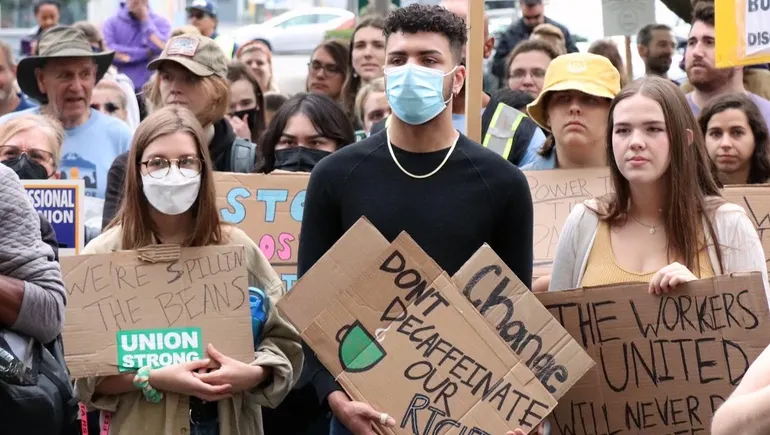
Last summer, Starbucks interim CEO Howard Schultz insisted on leaving two empty chairs at company meetings—one symbolizing the customer's presence, the other representing employees. During the early stages of the union campaign, workers told Restaurant Dive that they wanted not just symbolic seats, but real power to participate in decision-making. Now, the union's non-economic contract proposals are an attempt to give workers a voice in the company's day-to-day management.
Starbucks Workers United (SBWU) published 15 non-economic proposals on its social media pages. In union bargaining, non-economic proposals do not involve compensation-related topics such as wages and benefits, but instead focus on health and safety, dress codes, seniority rights, and anti-discrimination policies. SBWU's proposals fall into this category.
SBWU's proposals are based on the results of a bargaining survey conducted by its 60-person national bargaining committee over the summer. The committee collaborated with regional committees, single-store bargaining committees, union full-time staff, and attorneys to ensure the proposals reflect the demands of the broader workforce. Megan Brown, a member of SBWU's national bargaining committee, said the process was designed to ensure broad representation in the proposals.
By contrast, Starbucks has not made any public statements regarding its bargaining goals with the union. A Starbucks representative declined to comment on what the company hopes to gain from a contract.
Nevertheless, contract negotiation experts point out that companies typically want particularly broad latitude in management and personnel decisions.
"From management's perspective, the most critical thing is the management rights clause," said Gay Semel, a retired labor attorney with the Communications Workers of America. "The only limit on their power is the union contract."
Most contracts include a section outlining management's rights regarding discipline, termination procedures, and overall working conditions. The stronger that clause, the more desirable the contract is from the company's perspective.
Sid Lewis, a management-side labor attorney and union advisor, agreed, noting that broad employer power helps companies adjust operations more quickly.
"(Management typically) wants a strong management rights clause. They want to be able to move employees, hire and promote employees, and run the business as efficiently as possible without being bogged down by cumbersome procedures," Lewis said.
However, most or even all of SBWU's proposals could conflict with Starbucks' contract goals. Organizers from stores in Washington, D.C., Buffalo, New York, Illinois, and Massachusetts, along with union full-time staff, told Restaurant Dive what they hope to achieve in bargaining.

Top demand: Workers want more power in the workplace
Union workers interviewed by Restaurant Dive want influence over their working conditions, from company culture to apron-washing policies and everything in between.
Union organizer Aleah Bacetti said the proposal most important to her is the union's anti-discrimination proposal, which prohibits discrimination based on race and other factors. The proposal also exempts workers from handling food that conflicts with their religious beliefs, as Muslim and Jewish workers are currently required to handle pork products.
The proposal also expands Starbucks' anti-discrimination training. Starbucks had previously emphasized such training following a series of racial incidents at its stores. Bacetti believes the training is insufficient and argues that the union proposal requiring managers to undergo inclusivity training at least once a year could be crucial to stopping racial discrimination.
Bacetti, a Black woman, claims she was fired for union organizing activities and for using the n-word in African American Vernacular English (AAVE). In an email to Restaurant Dive, Starbucks said Bacetti was terminated for violating "Starbucks' anti-discrimination and anti-harassment standards."
"I was just speaking AAVE, which isn't even derogatory. Because I'm Black, I can speak that way," Bacetti said. Bacetti and other Black workers at her store had experienced racist behavior from customers, including, as Bacetti described, a white customer yelling the n-word at workers. Bacetti said the shift manager on duty did not ask the customer to leave until the customer made a Black worker cry.
"That guy wasn't banned because they don't care. It didn't harm anyone else's interests, but it harmed people of color," Bacetti said.
Starbucks baristas and SBWU members Tae Cunningham and Sam Shields also spoke about incidents where customers made workers feel unsafe and management refused to remove the customers or de-escalate the situation.
Starbucks said the company has policies for dealing with disruptive or unsafe customers, which require workers to ask the customer to stop the inappropriate behavior. The company said persistent disruption could result in the customer being asked to leave or being banned from the store. The union is calling on the company to allow employees to refuse service to customers who threaten workers.
Bacetti also claimed that shift managers abused and belittled Black workers, sometimes trying to withhold rest breaks that Black workers are legally entitled to, rather than adjusting staffing. Starbucks said all reports of violations of its anti-harassment and anti-discrimination policies will be fully investigated. Bacetti said she did not file a report with the company because she feared retaliation from managers, who would know about the report.
"When the shift manager is the very person you're having conflicts with over racial issues, it's hard to do," Bacetti said. "They'll laugh in your face."
The union is also calling for a "just cause" provision, which would provide workers with some protection against termination and establish a clearer process for discipline and written warnings.
"Starbucks has proven they can fire partners at any time for any reason," said Julie Langevin, a Starbucks shift supervisor and member of the union's national bargaining committee. "You can be fired for doing nothing wrong, or you can be fired for the most minor, perceived infraction."
Another way SBWU hopes to change how the company is managed is by establishing labor-management committees. The proposal would require store managers to meet monthly with union workers to discuss and resolve workplace issues, said Megan Brown, an SBWU national bargaining committee member and Starbucks barista. The proposal is also the union's response to the strong management rights clause Starbucks may seek. Brown said labor-management committees would allow the union and company to resolve workplace issues before they escalate into problems.
But one of the union's most radical demands is also one of its oldest. The union's fair election principles, a set of demands designed to make it easier for workers to organize, first circulated in August 2021 and were the first non-economic proposal the union put forward in this round of bargaining. The current version would also extend any contract or collective bargaining agreement at existing unionized stores to newly unionized stores nearby. For organizers, the substance of these proposals is a form of lasting power.
"What we're really doing is creating democracy in one of the wealthiest companies in the world," said Kylah Clay, a Boston barista and union leader. "It gives us back a sense of ownership over the workplace."
Starbucks' deep pockets could make bargaining more difficult
SBWU members say the union faces difficulties organizing new stores after multiple union supporters lost their jobs. According to Buffalo-area barista Casey Moore, internal union estimates indicate that more than 120 union supporters have been fired or forced out.
Starbucks maintains that all workers fired during the union campaign were terminated for policy violations, but federal courts have begun to side with the union, ordering the reinstatement of several workers.
Starbucks has also faced further scrutiny from the National Labor Relations Board (NLRB) over benefit changes. Semel noted that once a union is certified, management cannot change working conditions without bargaining—at least legally.
Earlier this year, Starbucks refused to extend new benefits to union workers, saying it needed to bargain with the union over those changes. But Workers United waived its bargaining rights on the issue, hoping union employees would receive the benefits. Starbucks neither bargained with SBWU nor extended the new benefits to union workers—a move that frustrated SBWU and drew criticism from the NLRB.
An NLRB regional office issued a complaint alleging Starbucks withheld benefit changes with the intent of discouraging employees from joining the union. The union said the benefit changes were inspired by demands raised by its members. But even with the NLRB as an overseer, SBWU remains highly vulnerable to Starbucks' power.
If SBWU reaches a contract with Starbucks, any such agreement could limit the union's freedom of action. Lewis said contract duration matters because no-strike clauses—nearly universal in U.S. union contracts—mean the employer enjoys a period of labor peace during the contract term. Lewis said most contracts last three to five years, and many employers prefer longer options because they widen the gap between labor conflicts and reduce the likelihood of strikes.
"(They) don't have to worry about any conflict except for the normal grievance and occasional arbitration (to resolve disputes)," Lewis said. "That's five years of peace."
Semel said smaller employers are often willing to accept longer periods of labor peace, but large companies with deep pockets like Starbucks may be less willing to compromise.
As an example, SPoT coffee, a Buffalo-area coffee chain, saw workers at multiple stores push for unionization in the spring of 2019. Workers United won that election in August 2019 and reached a contract with SPoT by March 2020, according to Barista Magazine.
Semel noted that larger companies may never reach an agreement with a union, and may never offer a contract that improves working conditions, although the NLRB sometimes treats such bargaining as an unfair labor practice.