
Reef pushes regulatory adjustments for urban ghost kitchens to fit its business model
Mobile ghost kitchen operator Reef Technology is working with multiple cities to develop pilot regulations to address operational restrictions its mobile food trucks face under current food truck rules. The company has pushed for regulatory reforms in Miami, Dallas, Orlando, and other locations, while also exploring alternative expansion paths such as hotel kitchens and physical storefronts.
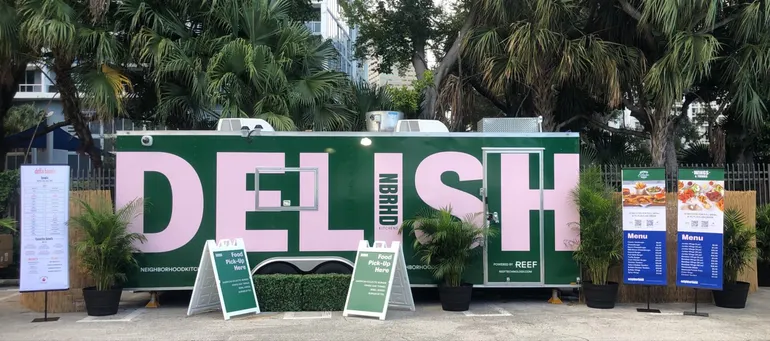
In several major cities, mobile ghost kitchens are currently subject to regulatory rules designed for food trucks, which operators believe may hinder their business growth.
Mason Harrison, communications director at Reef Technology, said that delivery-focused mobile food trucks, such as those operated by Reef, often conflict with existing regulations because many city laws require mobile kitchens to relocate every few days rather than remain stationary. Local regulations may also require mobile food units to return to a central food preparation facility more frequently than mobile ghost kitchen operators would prefer.
Such regulations are intended to prevent mobile kitchens from directly competing with brick-and-mortar restaurants in commercial areas, while also ensuring that food trucks and mobile kitchens remain clean and provide safely prepared food. Although Reef's food trucks are parked within its nationwide network of parking lots rather than on city streets, they are still required to move under these regulations—which poses an obstacle to Reef's operational model of keeping its food trucks as stationary as possible.
However, Reef is not content with merely complying with these laws; it is instead influencing major markets to develop new regulations.
This mobile ghost kitchen company, which uses trailers equipped with kitchens to cook food within its parking lots, has accumulated a series of high-profile permitting violations. In Houston, multiple Reef units were shut down after inspectors discovered they wereoperating without proper permits; in New York City, the company shut down some of its modular kitchens last October due toexpired permitsIn Florida, as of December 2021, out of the 61 Reef mobile units licensed in the state,58 had health violations, two of which were serious enough to require the temporary closure of the units involved.
Recent developments also suggest there may be some internal issues within the company. After Reef's operating permits expired in New York last year, ittemporarily suspended mobile kitchen operations. In December, celebrity chef David Chang's Fuku brand ended its partnership with the company after media reports that Reef food trucks frequently produced undercooked food. In May,Reef cut 5% of its global workforce. In June, Reef alsoreportedly removed Michael Beacham, its head of kitchen operations。
But the company is still seeking expansion and is working with local governments to develop regulations that will streamline its entry into new markets and its operations there.
To date, the company has worked with legislators and municipal officials in its headquarters city of Miami, as well as Dallas, Orlando, Florida, and Vancouver, Canada, to develop pilot programs supporting its mobile food trucks. But not every market is willing to modify laws for ghost kitchens.
"We don't encounter cities in every market that are as willing as Miami to consider our model," Harrison said.

Miami is the blueprint for Reef's regulatory goals
Michael Beacham, Reef's former president of kitchen operations, said last October that Reef's business model does not comply with existing regulations in many cities, but the company is trying to change that.
Miami City Commissioner Ken Russell said that before the pandemic, Reef did not seek approval from city regulators in advance when entering new markets.
"I've heard that several players in this industry believe they don't need government approval to operate in private parking lots," Russell said. "Even Reef initially had the same view, at least their lawyers did when they first came to this city."
Harrison said the process of co-developing regulations for new markets can be as simple as meeting with municipal staff to explain the exemptions Reef needs to operate its mobile food business. In Dallas, for example, according to the city'scode compliance departmentdocuments, mobile food units are legally required to return to a central kitchen every day, which disrupts operations.
According to Russell, in Miami, Reef's business model did not comply with existing regulations early in the company's operations.
"They were considered non-compliant because our ordinance was designed for food trucks, and it included a provision requiring them to move every few days," Russell said.
Russell worked with Reef early in the pandemic to distribute meals to constituents in need. Russell said this relationship led Reef to work with the city on a pilot program to accommodate Reef's business model and help it avoid fines and shutdowns. According to Miami city records, Reef hired at least six lobbyists to build relationships with the city.
Miami passed an experimental mobile food truck program developed in partnership with Reef on April 22, 2021,city records show. Previously, the city's regulations only applied to food trucks operated by a single person. The pilot program was supported by the Miami Downtown Development Authority, which submitted a letter of support to the city commission, framing it as a regulatory adjustment for the city's adaptation to technological development.
"Approving the REEF kitchen pilot program will allow REEF Technology to expand operations while working with the City of Miami to develop a one-year policy framework and promote urban innovation," the Miami DDA wrote.
But thefirst reading of the pilot ordinanceon March 11, 2021, did not go smoothly. Commissioners Joe Carollo and Manolo Reyes opposed an amendment that would have allowed Reef to engage in retail activities beyond food delivery. Reyes and Carollo successfully removed the amendment. Another city commissioner, Alex Diaz de la Portilla, offered a concise defense for updating the city's regulations.
"We are not creating a new world," Diaz de la Portilla said. "This world already exists."
The pilot program wasunanimously renewed on March 24, 2022, entering its second year.
"It was the right place, the right time, and the right people," Harrison said. "We invested early in Miami, we had relationships there, we had a commitment to the city, and we had people in the company with deep ties to elected officials and staff."
Harrison said those relationships date back to Reef's early days as a parking lot operator. But even in cities where Reef is a newcomer, the company, which promises innovation, has persuaded governments to implement pilot programs.
Reef has replicated its Miami model in Orlando. According to Jason Burton, assistant division manager of Orlando's city planning department, the city's planning department has long been discussing a ghost kitchen pilot program. Burton said Reef's mobile food trucks made the pilot program necessary, but Orlando was also seeking to change its ghost kitchen regulations to streamline city operations.
"We're not entirely influenced by Miami, but I think it helps us to have another city—especially one in our own state—dealing with the same issues," Burton said.

Hotel kitchens also present expansion opportunities
Harrison said Reef is also exploring expansion beyond its food trucks, especially in cities where the permitting process is lengthy or where city governments are unable or unwilling to launch pilot programs for Reef. Brick-and-mortar locations are one way for Reef to enter such markets, and hotel kitchens are a second.
Reef has reached agreements with an undisclosed number of hotels in multiple markets to operate ghost kitchens using underutilized hotel kitchens. Harrison said small hotels are particularly valuable because they typically have kitchens but rarely use them beyond serving continental breakfast.
"We're working with large brands that open up physical real estate for us in many markets," Harrison said. "Our corporate strategy for entering new markets and deepening penetration in existing ones will change."
The Miami pilot program does not apply to all neighborhoods in the city. Harrison said that in some neighborhoods, such as South Beach, the company operates entirely through hotels. Hotel kitchens can meet the company's need for physical real estate close to customers in areas lacking parking lots.
"In many markets, we still need brick-and-mortar locations," Harrison said. In certain segments, hotel kitchens serve as fulfillment kitchens replacing mobile food truck operations, Harrison said.
Reef is also looking at other segments of food service, having opened amobile food hall at Raleigh-Durham International Airport in July. Reef's chief creative officer, Alan Philips, said the company is interested in expanding its airport food operations.
"The company's strategy in the market has changed, and so has our regulatory path. Brick-and-mortar locations will be as important as, or even more important than, our mobile kitchen business as part of our strategy," Harrison said.