
Washington Wydown Coffee Shop Employees Unionize, Then Store Closes Entirely
Two Wydown coffee shops in Washington, D.C., suddenly closed four weeks before the union election vote count, potentially ending employees' organizing efforts.
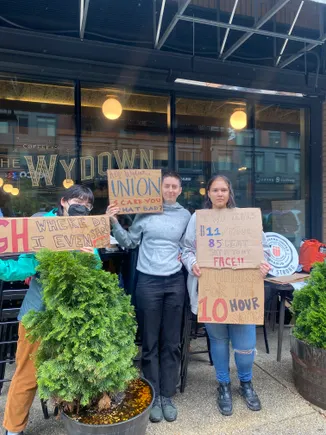
At 7:58 PM on May 14, all employees of Wydown Coffee were fired. The two-location coffee chain in Washington, D.C., suddenly closed that evening, less than four weeks before the National Labor Relations Board (NLRB) was scheduled to count votes in union elections at both stores. Employees had organized with Workers United, the union behind the Starbucks campaign.
The closure likely marks the end of the employees' union campaign—workers' ability to force a store to reopen is typically limited to partial closures, not a full business shutdown—and represents another setback for organized coffee shop labor in a city that has largely resisted the wave of unionization sparked by Starbucks Workers United's victories.
Alex McCracken, co-owner of Wydown, wrote in an email to Restaurant Dive that he and the other two co-owners decided last year that they were "ready for a change." A copy of the notice sent to staff by management also indicates the closure was the result of a long, unspecified process.
"Tuesday, May 14, was our last day of operations," McCracken wrote.
Employees received little advance notice. Tom Friedl, a pro-union barista at the former 14th Street Wydown location, said that on the Friday before the closure, an employee found a printed draft of the email in the office—an email that was later sent on May 14. Union lawyers and Wydown employees viewed the draft as a form of intimidation.
"There's no reason for them to just shut it down. The place seems profitable," Friedl said in an interview after the closure. He said the 14th Street store was busy, with sales exceeding $1 million last year. The second location on H Street in Northeast D.C. was equally popular. Friedl also said the company was still trying to hire new staff the week before closing.
McCracken did not respond to requests for comment about the stores' financial performance.
Despite the closures, Workers United still hopes to move forward with the NLRB elections originally scheduled for early June, which were to be conducted by mail-in ballot.
"The union is pushing to have the vote anyway," Friedl said. "If we win the election, [Workers United] can negotiate more effectively for severance."
Friedl said Wydown employees rejected an offer from the owners to pay workers for the remainder of the last pay period—since the stores closed mid-cycle—which employees saw as an excuse to avoid providing proper severance.
In union campaigns, "self-destruct" closures of businesses or parts of them are not uncommon. In Massachusetts, the four-location coffee chain Darwin's closed in 2022 during a contract campaign with Unite Here. Walmart famously eliminated butcher positions in its deli departments in 2000 after switching to pre-packaged meat. In 2017, the online media platforms DNAInfo and Gothamist were shut down by their owner shortly after a union election.
Wydown employees organized under difficult conditions
Full-service restaurants in D.C. have seen some labor organizing victories—employees at Jose Andres's The Bazaar, working with Unite Here Local 25, won voluntary recognition earlier this year—but local coffee shops have struggled to gain union representation.
Workers organizing at La Colombe locations nationwide won overwhelming elections at every organizing site, with one exception: a D.C. store where the union withdrew its election petition. Meanwhile, Starbucks Workers United has made limited progress in the capital, winning representation at just two coffee shops in the city. In nearby Richmond, Virginia—a much smaller city—SBWU represents four stores within the city limits and several more in the surrounding suburbs.
At Wydown, employees faced a sharp language divide between kitchen staff and front-of-house staff at the 14th Street location, a barrier that often stalls union campaigns before they go public.
"The back of house is almost entirely Spanish-speaking," Friedl said in a separate interview before the closure. "Only a few people in the front know a little Spanish."
The organizing campaign began among baristas at the H Street location, according to Josiah Batterson, the store's lead barista, in an interview before the closure. Holly Costanzo, a barista at the H Street store, said the campaign there had to rely on one employee—the head chef—to effectively act as a translator between the Spanish-speaking kitchen staff and the English-speaking baristas and bakers.
High turnover also made it difficult to build lasting majority support at the H Street location. The unit was also referred to by employees as the "Apollo" store, named after the apartment building where the coffee shop is located.
"When I joined Apollo, I was told they had a two-year retention rate, but it's dropped significantly since then," Batterson said.
Friedl said that at the 14th Street Wydown, only two baristas had worked there for more than a year, each about 18 months, while cooks had slightly longer tenures.
When employees went public with their union campaign in April, they initially filed for an election as a single bargaining unit, but management forced them to re-file as two separate stores, delaying the election. While single-store bargaining units can sometimes benefit unions by allowing them to gain a foothold in a store where they can win quickly, they can also make it easier for organized workers to be isolated and defeated. For example, employers can concentrate management surveillance on the store where they believe union support is weakest to quash organizing, rather than spreading those resources across the entire system.
"These were supposed to be the same store," Friedl said, adding that employees frequently moved between the two locations to cover staffing shortages.
"We have the same website. Every item we sell is the same. We have exactly the same drinks and exactly the same menu."
What drove them to fight
When Costanzo started at Wydown, they intended to unionize it. A previous organizing attempt at their last employer had failed.
"I didn't have a grand plan, but I thought, 'I still have all this energy,' and I wanted baristas to have it better," Costanzo said.
Through conversations with other employees, Costanzo found the store was ripe for organizing because many workers had conflicts with the manager at the Apollo location.
Costanzo said that manager was eventually fired for unrelated issues, but had previously inadvertently pushed many employees toward supporting unionization—stemming from an incident where the manager convinced the company's director of operations to fire an employee for knocking too loudly on the office door. Employees had to knock to enter the office, which housed the walk-in cooler where supplies like almond milk and oat milk were stored. Wydown's owners did not respond to requests for comment about working conditions or management practices.
"We had already started the organizing process," Costanzo said of the employee's firing. "But it was the final push for people. Because a lot of people felt that anyone could have been fired in that situation."
Other issues were deeper. Costanzo and Batterson said scheduling at the Apollo location was unstable. In one incident after the union went public, a shift lead was unable to work due to an injury unrelated to work, and management responded by cutting store hours rather than promoting a new shift lead. Scheduling and pay were ongoing issues.
"Nobody works more than 30 hours a week," Friedl said.
Batterson said that during the interview process at Wydown, he was told that as a lead barista—a position one level above shift lead—he would earn $20 an hour. However, when he started, he earned only $16 an hour. Batterson said baristas earned $11 an hour.
For context, according to the D.C. Office of Unemployment Compensation, the minimum wage for tipped workers in the District is $8 an hour—the District is phasing out the tip credit—while the non-tipped minimum wage is $17. According to MIT's living wage calculator, the living wage for a single adult in D.C. is $23.90 an hour. According to CNBC, Washington is one of the most expensive cities in the U.S., ranking 7th in cost of living.
Batterson joined the company because management told him during the hiring process that they planned to open a third location, which would offer advancement potential for skilled workers.
Staffing was another chronic issue at the Apollo location. Costanzo said that on the front of house, there was typically only one shift lead and one other employee on duty, with only a brief overlap with the second employee mid-shift.
"Our store was getting busier," Costanzo said. "It could definitely be overwhelming to handle."
Baristas had to help serve and prepare the store's full menu in addition to making drinks, handling the register, and managing online and third-party orders. Costanzo said the staff on duty simply wasn't enough to meet demand.
For the back-of-house staff at the Apollo location, the working environment was physically uncomfortable; the kitchen had no air conditioning. Kitchen staffing also made it difficult for workers to take breaks—typically only two people were in the kitchen at a time—meaning cooks often worked continuously without rest while the ovens ran at full blast and without any ventilation.
In contrast, the 14th Street location was generally better staffed but had its own unique issue: water intrusion.
"We frequently had issues with water suddenly gushing up from the crack between the floor and the wall under the sink," Friedl said. "It's been like that since last summer."
Friedl said the water flooding the store was likely the result of a broader issue with the building's plumbing system, rather than the Wydown sinks themselves.
"Once, it smelled like sewage. I've also had it smell like rotten fish. It's wastewater coming from somewhere. It's definitely not a safe working environment, especially for food service," Friedl said. "They just wouldn't close. They refused to close."
Friedl said employees eventually felt the issues were unbearable: the bathroom at the 14th Street location had no ventilation, and the steam wand on the espresso machine leaked scalding hot water. Friedl said he was burned multiple times using the machines, and Costanzo said much of the equipment didn't function properly.
"Between the two stores, we have four espresso machines," Costanzo said. "Only one works fully, able to pull shots and steam milk. The others have some parts that work, but not fully."
Now, the issue of functional espresso machines is moot; Wydown no longer exists. Employees have held multiple pickets since the closure and have received strong community support as they continue to fight for severance. As of Wednesday, they had not yet received a compensation package from management.
"You can't put much pressure on a business that no longer exists," Friedl said. "We've done what we can."