
Chipotle Enhances Supply Chain Visibility with RFID Technology
Chipotle's vice president of supply chain, Carlos Londono, said the company has required all suppliers to attach RFID tags to products, making it the first restaurant chain to deploy the technology on a large scale. After completing a pilot at 200 stores in the Chicago area, the company is on track to roll out RFID to all 3,500 restaurants by year-end to improve inventory management, limited-time new product supply, and end-to-end traceability. Additionally, Chipotle is advancing a supplier visibility project with the Oracle platform and plans to upgrade its existing ERP system.
When supply chain operations rely on third-party outsourcing, visibility becomes key.
This experience is particularly profound for Carlos Londono, Vice President and Head of Supply Chain at Chipotle, whose supply chain system relies heavily on third-party partners.
"Our supply chain is 100% outsourced, and all the plants that process chicken, cheese, and other products are managed by our third-party partners," Londono said.
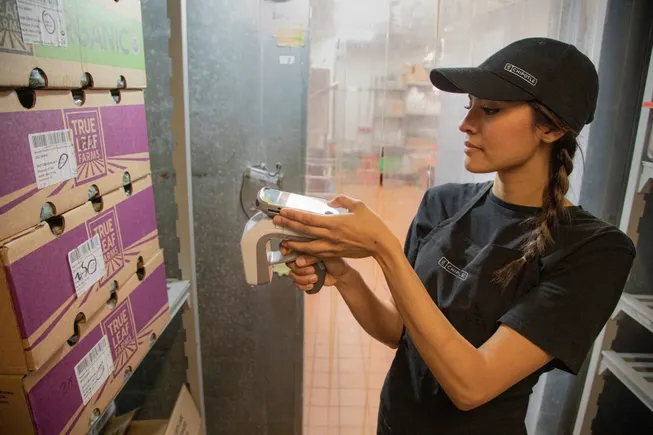
Chipotle has required all suppliers to affix radio frequency identification (RFID) tags to their products—a type of smart barcode that can automatically identify and track inventory. Although this technology is already common in retail, Londono noted that Chipotle is the first restaurant chain to put it into actual operation.
In a conversation with Supply Chain Dive, Londono highlighted Chipotle's progress in promoting the nationwide rollout of RFID technology, the operational improvements it has brought, and future plans to enhance inventory visibility.

RFID Supplier Integration and Nationwide Rollout
After a successful pilot at 200 restaurants in the Chicago area, Chipotle is now working to roll out RFID technology nationwide.
"After the pilot concluded, we immediately began a full-scale rollout at the supplier level, ensuring all suppliers are equipped with the necessary technology, software, printers, and infrastructure to support RFID implementation," Londono said.
Londono said that after completing the supplier level, the company adopted a pragmatic approach to store integration: starting with a single restaurant, resolving operational issues, then expanding to a group of stores, and finally to an entire region.
Londono revealed that Chipotle recently completed RFID deployment in Southern California with good results. The company has established a regional rollout schedule and expects to complete the transition across all regions by the end of this year.
"Our plan is to have RFID coverage across all 3,500 restaurants by the end of the year," Londono said.
Application of RFID in Limited-Time Offerings
For limited-time offerings like Chipotle's Chicken al Pastor, the supply chain requires significant advance preparation, typically starting a year before the product launch, Londono said.
To launch a new product, the company must bring in additional suppliers. Londono noted that even when the same limited-time product is repeated annually, the number of required suppliers increases each year.
"We need to bring in new chicken suppliers, sauce suppliers, and various other resources, which requires considerable effort," Londono said.
During the early stages of new product launches like Chicken al Pastor, information is often very limited. At this point, precise inventory monitoring becomes crucial, and RFID technology helps fill potential data gaps.

Traceability is another improvement brought by RFID—the company can now track the path of products through the supply chain network, including which distribution center they passed through and which transportation company carried them.
Additionally, once shipping data is sent from distribution centers, restaurant managers can quickly access inventory information, and this speed improvement is also valuable, Londono said.
Before RFID technology was applied, Chipotle restaurant managers had to manually scan barcodes one by one, which was time-consuming and labor-intensive. With RFID, managers can simply stand near a product box and the scanner reads the information immediately, Londono said.
"Whenever there's an opportunity to use technology to reduce labor burden or improve the efficiency and effectiveness of restaurant teams, we fully support it," the executive said.
Next Step: Collaborating with Oracle on New Technology and ERP Upgrade
Chipotle's pursuit of a technology-driven supply chain does not stop at RFID. The company is currently advancing a project called "Supplier Visibility" based on the Oracle platform.
The project integrates multiple technologies, enabling the company to view upstream inventory, shipments, and supplier information, Londono said. "We are continuously advancing and gradually bringing new suppliers into the project," he added.
Chipotle is also collaborating with Oracle to upgrade its existing enterprise resource planning (ERP) system.
Londono said Chipotle's original master data management system had worked well, but the company has now reached a stage where it needs a "next-generation" solution.
"Any company, especially when it reaches a certain scale, must have some kind of centralized ERP system," Londono said. That is why the company believes it is necessary to enhance its ERP capabilities.
Londono is working with the technology team to explore which additional modules and features can be enabled to continuously enhance visibility across Chipotle's supply chain.