
Dessert concept stores see record growth, but can the craze last?
Dessert concept stores are experiencing record growth, with brands from rainbow ice cream to cookies expanding rapidly. However, behind the craze lie challenges such as declining per-store sales and difficulties in site selection. This article analyzes the growth drivers, business models, and future risks.
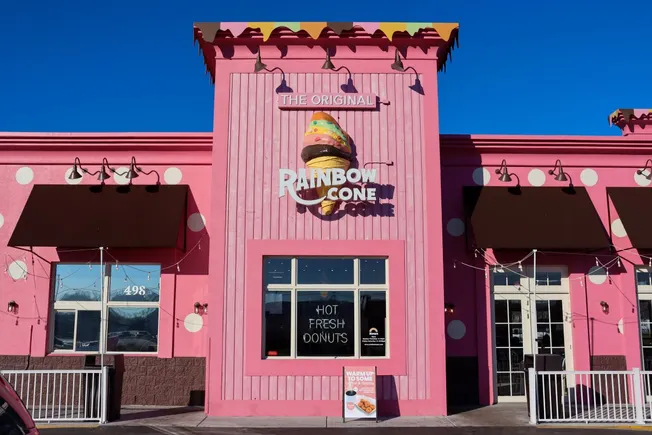
In an unassuming corner on Western Avenue in Chicago's Beverly neighborhood, a pink building has become a local landmark. Since 1926, The Original Rainbow Cone has been serving five-layer ice cream cones here, featuring flavors such as chocolate, strawberry, Palmer House, pistachio, and orange sherbet.
Nearly a century after its opening, third-generation operator Lynn Sapp sought opportunities to expand the family legacy in 2018 through a strategic partnership with Buona Companies.
In 2021, Buona Companies opened locations for the ice cream brand in the Chicago area and new markets, creating various formats including self-service kiosks and drive-thrus. John Buonavolanto, sales director at Buona Companies, said Buona also developed new store designs, adding polka dot elements to the pink exterior and decorating the interior with murals and other vibrant decorations.
Over the past three years, Rainbow Cone has grown from 1 location to 20, with another 30 being developed through franchising across states including Texas, Florida, Tennessee, Indiana, and Wisconsin. Buonavolanto said that within the next five years, Rainbow Cone will have 100 locations nationwide.
Rainbow Cone's rapid expansion reflects a larger trend in the dessert shop sector. Chains such as Nothing Bundt Cake, Dirty Dough Cookies, Sprinkles, Schmackary's, and Jeremiah's Italian Ice have all set ambitious growth plans for the next five years or more. Crumbl, founded in 2017, opened its 1000th location earlier this year.
Buonavolanto said, "I think there's a lot of innovation in the dessert space right now, especially in ice cream. You see many brands coming out with fun flavors and different products."
According to Yelp data, from May 2023 to April 2024, the number of dessert shop openings increased by more than 50% year-over-year, with related concepts like shaved ice seeing double-digit growth. Openings for concepts focused on pancakes, waffles, crepes, ice cream, frozen yogurt, and donuts also increased.
Alison Lin, head of Yelp's restaurant business, said, "Instead of going to a high-end restaurant for an expensive meal, dessert is a way to treat yourself that's still affordable."
Gen Z consumers tend to discover and share desserts through social media, which helps boost awareness of shops and flavor trends. Buonavolanto said Rainbow Cone is very popular on social media, with people often taking photos in front of the mural wall and posting them on social platforms.
Buonavolanto said, "We updated the store design to make it very vibrant, keeping the fun and colorful feel of the rainbow cone and applying it to the store design. We created many of these photo opportunities... to create a fun, interactive, and memorable experience for customers."

Why desserts are growing
Although overall consumer spending has decreased, they still consider desserts and snacks worth the expense. Dolf Berle, CEO of Nothing Bundt Cake, said, "As millennials and Gen Z face challenges from uncertainty, 'little treats' have become a powerful coping mechanism."
According to a Datassential survey, 53% of consumers said they had eaten a dessert in the past day, and 18% said they eat dessert at least once a day. Berle said, "In times of economic uncertainty, consumers may cut back on big-ticket items but still maintain a sense of normalcy and pleasure through small dessert purchases."
Nothing Bundt Cakes has set a goal of reaching 1000 locations by 2027, opened its 600th location in June, and plans to open 150 new stores each year. Berle said the chain will invest heavily in digital to better resonate with both older and younger customers.
Berle said, "We know that even in towns where we already have stores, customer awareness is far below 50%. As we grow our social media and digital presence, we believe our stores' financial performance will reach the next level."

The business logic of dessert concepts
The growth of dessert chains has also attracted interest from investors and franchisees. Erik Herrmann, partner and head of the investment group at CapitalSpring, said dessert shops typically have simple business models and limited product portfolios, leading to operational efficiency. Dessert concepts usually occupy small spaces, resulting in cost efficiency and better returns on capital.
Gregg Majewski, CEO of Craveworthy Brands, said he was drawn to Dirty Dough not only because he wanted to round out Craveworthy Brands' portfolio with a snack product, but also because he wanted a consumer brand that could expand into grocery stores. Having cookie production capabilities allows the brand to act as a wholesaler and add other foodservice brands on top of that, while also providing existing franchisees with another concept to pair.
Majewski envisions that in five years, Dirty Dough will have 500 to 700 locations, products in grocery stores across the U.S., and an established private-label business. The brand is already nationwide, and Majewski wants to fill markets with appropriate population density and income levels, potentially reaching 1200 to 1500 locations.
Rainbow Cone has a strong mix of single-unit and multi-unit franchisees, with about 75% being multi-unit agreements. Buonavolanto said opening three or more locations within a few years is the best way to enter a new market. He said Rainbow Cone is easy to operate and offers a quick return on investment.
Buonavolanto said, "I think people need to make sure they have the best employees, provide quality and fast service, and not cut corners on the recipe or use cheaper ingredients to save money."
Not all concepts last
Despite relatively simple operations, dessert shops still face significant challenges. At Dirty Dough, construction progress has been slower than expected. Majewski expects to open 50 locations this year, down from a previous forecast of 75, due to difficulty finding small real estate—the brand typically needs 800 to 1200 square feet. He said this size has not been attractive to landlords, making it hard to find in the real estate market.
Before being acquired by Craveworthy, the chain sold 411 locations in less than 18 months, so now the issue is getting franchisees open and moving forward.
Additionally, maintaining strong sales trends is a major challenge. Majewski noted that single-concept dessert brands often spike and then decline because, before the fad fades, only a limited number of people will come for a single product. He said, "Look at the trends in (frozen) yogurt, cupcakes, and other categories. We hope to sustain sales by offering a variety of products and avoid these declines."

Concepts that have expanded rapidly are beginning to slow down. Crumbl reached its 1000th location earlier this year, but revenue growth slowed last year. According to QSR Magazine, Crumbl closed 7 locations in 2023—its first closures in history. Average revenue for 571 of its 970 locations was $1.16 million in 2023, down 37% from $1.84 million the previous year.
Herrmann said timing is key when investing in such concepts. He said, "In the dessert space, there are many examples of hot concepts that are no longer hot because something new comes along." Dessert concepts are a worthwhile investment direction, but potential investors need to be aware that their popularity fluctuates more than typical restaurant businesses with more stable demand, such as pizza or sandwich shops.
Adding more desserts and flavors
One way to keep customers coming back is to add different flavors and categories that pair well with the core menu. For example, beverages are often easy to add and have high profit margins, and they don't add much operational complexity in terms of equipment, Herrmann said. As long as it doesn't change the complexity of new equipment or the investment cost, any menu addition helps the business. Crumbl has diversified its menu by adding items such as Cinnamon Squares, Tres Leches Cake, and Carrot Cake.
Herrmann said, "You add revenue layers to the consumption occasion, usage occasion, business, and menu. This diversifies the business and may make it stickier in terms of demand."
Dirty Dough has been adding items such as Dirty Sodas, offering rotating flavors like Carribean Crush, Dreamsicle Delight, and Dirty Jr. In test stores, Dirty beverages account for 15% of total sales. It has also added products like edible cookie dough and ice cream sandwiches. Some locations serve coffee drinks such as frappuccinos and espresso.
Majewski said, "We're trying to be a cookie-centric dessert restaurant where customers can visit multiple times. It's all about traffic, and that gives us an edge in the competition for footfall."

Rainbow Cone has also added new products over the past few years, recently introducing sliced ice cream with stacked layers of different flavors such as Orange Dream, Chocolate Obsession, Minty City, and Cosmic Birthday. The chain added made-to-order mini donuts in 2021, which can be used to make sundaes or as toppings on milkshakes.
Buonavolanto said, "These additional menu options are meant to reach more customers." He said the menu expansion has been well received by customers and "gives people a reason to try something new." For example, sales of sliced ice cream have exceeded expectations.
Buonavolanto said, "Those operators who can innovate and create new reasons for customers to choose their dessert shop or ice cream shop over others will be successful."