
How Four Chain Brands Are Catching Up with Chipotle's Expansion Pace
Chipotle, with its company-owned model and Chipotlanes drive-thru lanes, achieves an average revenue of $3.15 million per store and plans to expand to 7,000 locations. Facing this giant, four chain brands—District Taco, Qdoba, Moe's Southwest Grill, and Burritobar—are exploring their own paths to catch up, centering on franchising, combined with regional characteristics, menu differentiation, and smaller store formats. This article analyzes these brands' strategies, challenges, and industry prospects.
In the fast-food industry, franchise brands like Dunkin', Subway, and McDonald's have long been household names. However, the fast-casual dining sector has not universally adopted the franchise model. Brands such as Chipotle, Starbucks, Shake Shack, and Cava have achieved leading positions in their categories through company-owned operations.
Among these companies, Chipotle has the most impressive financial performance. According to its Q2 2024 10-Q filing, Chipotle's average unit volume (AUV) across its 3,530 restaurants is approximately $3.15 million. The company is moving toward its goal of 7,000 restaurants, and the addition of 'Chipotlanes' drive-thru pickup lanes has further boosted average unit volumes. Of the 52 new restaurants opened last quarter, 46 were equipped with Chipotlanes, making this feature central to its expansion strategy.
Chipotle's success is sparking a new wave of competition. Regional brands, established challengers, and new international entrants are using franchising and menu strategies as key differentiators against the giant. Chipotle's scale is so vast that even its annual spring hiring campaign targets tens of thousands of people.
Ab Igram, executive director of the Tariq Farid Franchise Institute at Babson College, noted that the franchise model allows brands that struggle to access capital for company-owned growth to accelerate expansion with experienced or well-funded franchisees. "Chipotle defined the market," Igram said. "Customers crave this model. The opportunity lies in whether a brand, a new concept, or a regional concept can find its own point of differentiation."
Chains like District Taco, Moe's Southwest Grill, Qdoba, and Burritobar are attempting to expand nationally, but reaching Chipotle's scale and sales may still take time. Here are the specific strategies these four brands are using to catch up to Chipotle.
District Taco: Differentiating with Yucatán flavors
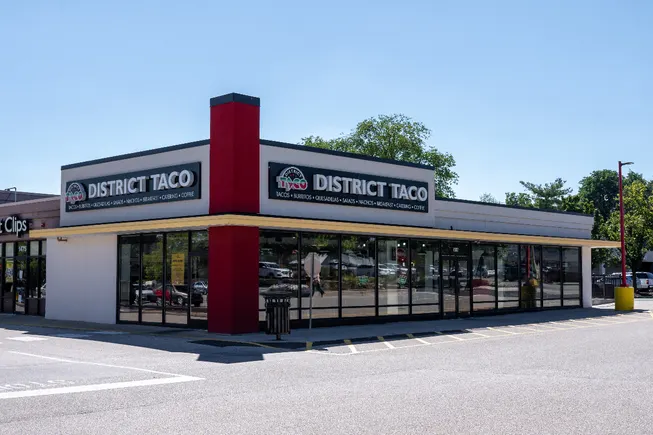
District Taco is a fast-casual brand with 17 locations, primarily in the Washington, D.C. area and surrounding markets, making it one of Chipotle's smaller competitors. But its CEO and co-founder Osiris Hoil believes the brand has a secret weapon: authenticity. Hoil moved to the U.S. from Yucatán, Mexico at age 17, when he struggled to find Mexican food that evoked memories of home.
The brand's core differentiation lies in its understanding of traditional flavors: habanero peppers, roasted tomatoes, and garlic. District Taco particularly emphasizes habanero peppers, a common ingredient in Yucatán cuisine, but with a heat level far exceeding the jalapeños many American consumers are accustomed to. By offering customizable toppings, the brand satisfies consumers' desire for personalization while maintaining the Mexican flavor foundation of its menu.
Beyond authenticity, District Taco has expanded into more dayparts. The brand serves breakfast, opening between 7 a.m. and 10 a.m. According to Hoil, breakfast tacos now account for about 10% of its sales.
In its expansion strategy, District Taco primarily partners with experienced franchisees who often already own other brands and want to diversify their portfolios. In site selection, the company seeks a balance between affordable rent and location. The brand aims to grow in suburban markets, building organic connections with customers through partnerships with universities, sports teams, and other local institutions.
Hoil said the company may need about 15 years to become a truly national brand. Currently, the chain has signed development agreements for at least 71 restaurants, with locations already open in Washington, D.C., Virginia, Maryland, Pennsylvania, and New Jersey, and plans for a new location in Orlando, Florida.
Qdoba: Cash incentives to accelerate restaurant development
In June, Qdoba announced it would offer a $100,000 cash incentive to franchisees who complete new restaurant construction by September 2026. Qdoba's Chief Development Officer Jeremy Vitaro said that if a location is in an end-cap or inline space, it typically takes 12 to 15 months to complete, so a significant portion of franchisees should be able to earn the bonus.
"We want to achieve a goal of 100 net new restaurant openings per year over the next few years, and we're working toward that," Vitaro said. He emphasized the advantages of franchising: "You find great people with strong local resources and market knowledge who can hire staff through their networks, develop restaurants, run local marketing, and engage deeply with the community. That's our ideal franchisee."
To strengthen the brand, Qdoba plans to remodel 80 of its 165 company-owned restaurants this year, although it may sell some company-owned locations to franchisees in the future. Vitaro said the remodels are intended to "bring the restaurants up to date." Future strategy also includes shifting site preferences toward smaller footprints of 1,800 to 2,000 square feet, compared to the current average of 2,500 square feet. This aligns with the trend of brands like Potbelly, Panera, and Sweetgreen developing smaller-format locations in recent years.
Unlike Chipotle, Qdoba has not made digital pickup lanes a development priority. Vitaro said the percentage of locations with digital pickup lanes will gradually increase, but it is not central to the brand's development. "Our restaurants are more than just transaction points," Vitaro said. "There's a warmth and hospitality in our restaurants that sets us apart from some competitors."
Moe's Southwest Grill: Driving net growth
As one of Chipotle's largest franchise competitors, Moe's Southwest Grill has seen its store count decline in recent years, dropping from 681 locations in early 2021 to 612 by the end of 2023 (according to its franchise disclosure document). But Brian Krause, chief development officer of parent company GoTo Foods, said the brand is poised for a turnaround following a restaurant redesign.
"We've moved from darker tones in the past to brighter, more energetic colors," Krause said. "We're also optimizing the customer experience, reducing furniture and equipment in the front of the restaurant." Additionally, the brand is working to lower costs, improve efficiency, and leverage the parent company's purchasing scale and bargaining power.
Reducing costs for franchisees is critical for Moe's because the brand's average unit volume (AUV) is relatively low at around $1.2 million, and its franchisee base is fragmented. Currently, Moe's has about 150 franchisees operating 606 franchised locations, with each franchisee operating an average of about 4 restaurants.
In recent years, Moe's has re-examined various costs to strengthen franchisee margins and has tied marketing strategies to the popularity and profitability of menu items. Krause noted that the brand's franchisee base is gradually consolidating, consistent with the fast-food industry's trend toward experienced multi-unit operators, but the brand still wants to retain a certain number of smaller operators.
Like other brands in the segment, customization is key to Moe's menu strategy. While the overall menu is simple and consistent, the brand offers a variety of fresh toppings such as diced onions, black olives, and fresh or pickled jalapeños, which Chipotle does not offer. Additionally, the brand is moving toward making fresh salsa in-house.
Krause said these changes mean the brand is slowly recovering. Moe's signed a five-location expansion agreement in Arizona in July, but Krause expects the brand won't return to net growth until 2025.
Burritobar: Dual innovation in menu and model
Burritobar, the U.S. division of Canada's Barburrito, is signing large development agreements at a remarkable pace. Since April, the brand has signed at least 7 master franchise agreements totaling approximately 500 restaurant commitments. As of early July, Burritobar had secured 750 development commitments in the U.S., but only 4 locations are open (3 in Michigan and 1 in Delaware), according to Chief Development Officer Jeff Young.
The key to its growth lies in the menu, which is distinctly different from traditional Mexican fast-food bowls, burritos, and tacos. "We have frying equipment, so we can offer a more diverse range of products, including signature items like bang bang shrimp, crispy chicken, fried chickpeas, extreme fries, and freshly fried churros," Young wrote in an email to Restaurant Dive. The brand doesn't pretend to offer authentic Mexican cuisine; Young describes its menu as 'Mexican-inspired.'
Its development strategy focuses on smaller locations ranging from 1,000 to 1,500 square feet, typically in inline or end-cap positions in open-air shopping centers. "Smaller locations reduce initial capital expenditure, and combined with our lower ongoing operating costs and streamlined labor model, franchisees can achieve profitability faster," Young said.
Geographically, the brand is focusing on the eastern U.S. to leverage proximity to its Toronto headquarters, supporting growth and building brand awareness. Young said this process begins in secondary and tertiary suburban markets before expanding to denser urban areas, a stark contrast to Chipotle's early urban-focused strategy.
Industry outlook: Challenges and opportunities coexist
Smaller locations, differentiated menus, and larger franchisees may help some brands grow quickly or recover from decline, but not all Mexican fast-casual chains are thriving. Tijuana Flats closed 11 locations in the spring, filed for Chapter 11 bankruptcy, and was acquired by new owners. Rubio's Coastal Grill also filed for Chapter 11 bankruptcy after closing dozens of locations in May and June.
Vitaro believes these bankruptcies reflect specific issues rather than industry-wide weakness. "I don't think the market as a whole is anywhere near saturation," Vitaro said. "Overall, it's a healthy market."
Igram said brands should ensure they can capture a share of the market, but whether there's a ceiling for the Mexican fast-casual market remains unclear. "You can truly compete with Chipotle and win in one market, but you might not in another," Igram said. However, chains don't necessarily have to beat Chipotle to be profitable. Igram noted that brands can grow by ensuring attractive unit economics that provide a good return on investment.
"Any brand has to work very hard to stay relevant, offer the right value and experience, and hire the right people," Vitaro said. "If you're a franchise brand, like we are, you also have to find the right franchisees. All of that is extremely challenging."


