
Los Angeles Pandemic Anniversary: Restaurant Industry Feels Abandoned Amid 'Arbitrary' Restrictions
A year after the pandemic outbreak, Los Angeles' restaurant industry struggles to survive amid repeated outdoor dining bans. Practitioners accuse policies of being arbitrary and lacking data support, as the industry faces multiple blows from store closures, sharp employment declines, and sales drops. Although courts overturned the ban, state-level orders kept outdoor dining suspended for an extended period. This is the third piece in a series, analyzing the complex relationship between policies and pandemic data.
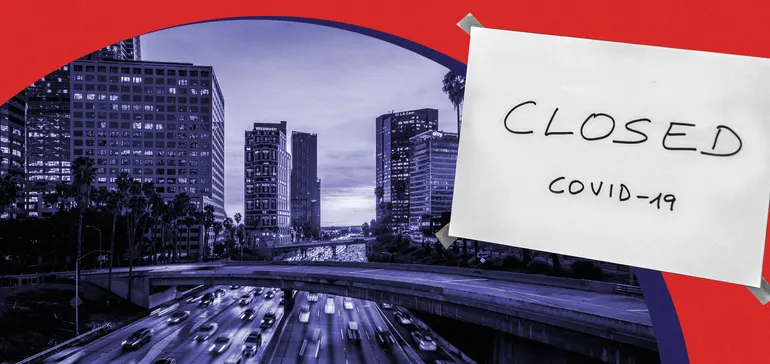
This article is the third in a six-part series exploring how major dining cities have been impacted by the pandemic. Subsequent articles willbe published here。
Overview
- Restaurant closures:Between January 2020 and March 3, 2021, the number of small businesses in California's leisure and hospitality industrydecreased by 48.2%
- Restaurant job losses:From January 2020 to January 2021, Los Angeles County lost 122,700 jobs,a decrease of 33.7%
- Restaurant sales losses:Compared to the same period in 2019, restaurant sales in Los Angeles during the week of March 11decreased by 33%
"(The government) gave up on dialogue with the restaurant industry and instead said, 'We'll just give you some arbitrary instructions and then let you figure it out on your own.'"
Caroline Styne
Co-founder of The Lucques Group
On paper, Los Angeles' near-constant sunshine, mild climate, and vast spaces should have made it an ideal dining market to operate in during indoor dining closures. But California's aggressive response to the pandemic—including two rounds of months-long outdoor dining bans—weakened restaurant sales during the "winter best suited for outdoor dining," said Caroline Styne, co-founder of The Lucques Group.
"We had the driest winter... The weather was very mild. It's colder now than it was then," Styne said last week.
The most recent time, outdoor dining was closed from November 25 to January 9, cutting off local restaurants' ability to serve any customers during the holiday peak season.
These restrictions nullified a major advantage Los Angeles restaurants had over markets in the Midwest and Northeast—where operators struggled to attract diners into igloos or around heat lamps in the bitter cold. For Styne, this loss was a major point of frustration, as she believes municipal officials lacked evidence linking restaurant indoor dining to the spread of COVID-19.
"We operated outdoor dining for four months... Cases in the city were declining. Then in October they allowed private gatherings... Sure enough, cases spiked," Styne said. "Then they closed restaurants... without providing any evidence or data to show that this was causing the increase in cases... The county cited a CDC report from six months ago from across the country, which wasn't about outdoor dining—it was about indoor dining."
That frustration erupted in November when the California Restaurant Association sued Los Angeles County over the outdoor dining ban, arguing the restriction was "arbitrary and capricious" because officials could not provide a link between outdoor dining and COVID-19 transmission. The association won the lawsuit—a Los Angeles judge issued an injunction in early December,overturning the outdoor dining closure order—but it was moot. California's regional stay-at-home order also included an outdoor dining ban, which superseded the county's order. The city's outdoor patios remained empty.
The restrictions came at a heavy cost. According to GroundTruth data, in February 2021 compared to March 2020, Los Angeles saw the most severe decline in foot traffic across fine dining, fast food, and casual dining among six cities (Los Angeles, Seattle, Chicago, Miami, New York, and Washington, D.C.). The city also lost 122,700 restaurant workers—a 33.7% decrease between January 2020 and January 2021.
The county also faced a severe COVID-19 outbreak. According to CNBC, cases in Los Angeles County increased by 905% from November to January. Mayor Eric Garcetti said in an interview on CBS News' "Face the Nation" in January that at that time, 10 people in the county were contracting COVID-19 every minute. That same month, California's per capita infection rate was higher than any country in the world, reporting 658 new cases per 100,000 people.
How much restaurant revenue, employment, and locations could have been saved if outdoor dining had not been banned is unknowable. However, an open question remains: whether Los Angeles' dining restrictions actually helped reduce local COVID-19 infection rates, and whether those restrictions were worth the losses suffered by the restaurant industry.
How Los Angeles dining policy changes affected COVID-19 infection rates
Percentage increase in new COVID-19 cases before and after changes to restaurant capacity restrictions.
Governor Gavin Newsom first closed indoor dining on March 17 of last year, allowing only takeout, delivery, and drive-thru service until the end of May. Restaurant Dive, using data from the Los Angeles County Department of Public Health, calculated the percentage increase in COVID-19 cases following each subsequent dining policy change, including both restrictions and capacity relaxations.
Similar to several major cities, infection rates spiked in the first month regardless of restrictions, as experts struggled to provide consistent guidance and testing protocols. Los Angeles saw a 7,333% increase during this period. After 60 days, cases rose by 19,011%.
When Newsom ordered Los Angeles restaurants to close outdoor dining for the second time on November 25, COVID-19 cases increased by 86% after 30 days. By January 24, cases had increased by 175%.
However, these data do not tell the full story, as factors such as travel and personal gatherings also affect COVID-19 transmission. This gray area makes it difficult to assess whether restaurant capacity restrictions can truly slow the spread among the population, which has also led to differing approaches to dining guidelines among local governments nationwide.
"I firmly believe (transmission) is not happening between restaurant tables," Styne said. "Did I see five young people take off their masks outside and hug each other, saying 'Oh, long time no see'? Yes, I did. I'm not saying people's foolish behavior isn't a cause of transmission. But it's not caused by restaurant operations."
Timeline of COVID-19 dining restrictions
