
Miami Pandemic Anniversary: Sunshine and Loose Restrictions Fuel Restaurant and Real Estate Boom
A year after the pandemic, Miami attracts restaurant investment with loose restrictions and warm climate, but the pandemic's impact and policy fluctuations still cast a shadow.
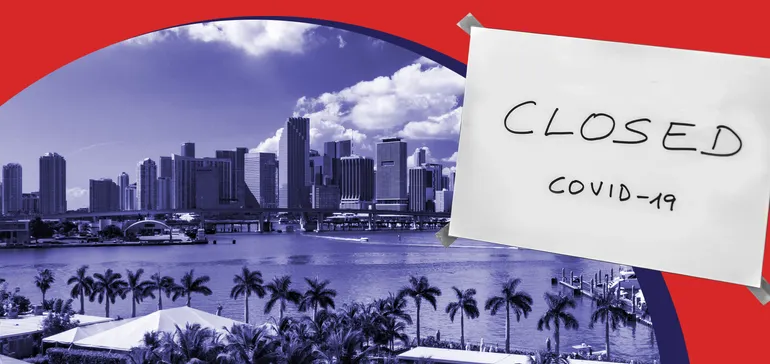
While restaurants across the United States struggled with prolonged closures of indoor and outdoor dining and a harsh winter in some regions, the sun shone on Miami operators.
Compared with the plans formulated by governments in places such as Los Angeles, New York City, Seattle, Chicago, and Washington, D.C., Miami-Dade County's response to the pandemic was relatively lenient. After the first few weeks of the outbreak, restaurants were allowed to offer outdoor dining, making full use of the area's scenic terraces, open spaces, and sea breezes.
However, the pandemic still took its toll. According to data from Florida International University's FIU Chaplin School of Hospitality & Tourism Management, between March and August 2020, restaurant revenue in Miami-Dade County lost $742 million compared with the same period in 2019. As of March 15, total revenue for small businesses in Miami had fallen by 31.5%.
Restaurants in Miami-Dade County were also affected by repeatedly changing restrictions, with former Mayor Carlos Gimenez and Governor Ron DeSantis sometimes issuing conflicting directives.
The region's COVID-19 case rate is improving. On March 24, Miami reported 1,058 new cases, a 69.2% decrease from the city's daily peak of 3,440 new cases on January 8, according to data compiled by The New York Times.
Earlier this month, Miami-Dade County Mayor Daniella Levine Cava (who took office after Gimenez's term ended in January) said that if the current infection rate remains stable and the 14-day average positivity rate reaches 5.5% or below by early April, the curfew in the market (currently midnight to 6 a.m.) could be gradually lifted. This could help local restaurants boost alcohol sales, which is crucial for operators with thin profit margins. However, if the positivity rate exceeds 6%, the curfew could be reinstated.
Nevertheless, this timeline could still be disrupted by the recent influx of large numbers of tourists to Miami Beach for spring break. On March 20, the city declared a state of emergency, suspended outdoor dining at restaurants in "high-impact areas," and implemented a 72-hour lockdown. The city plans to extend the state of emergency to reduce crowds.
"We have too many people here, too many people wanting to engage in reckless behavior during the pandemic," Miami Beach Mayor Dan Gelber told USA Today earlier this week. This closure could set back the progress of Miami restaurants just as many other dining markets are beginning to rebound due to widespread vaccination and loosened restrictions.
Although government measures are intended to protect the public, Miami operators will never know how much revenue, jobs, and restaurants could have been saved if measures such as service curfews and capacity limits had not been implemented.
How Miami Dining Policy Changes Affect COVID-19 Incidence Rates
Miami-Dade County closed indoor dining on March 17 last year, allowing only takeout and pickup services until mid-May. However, reopening was inconsistent—DeSantis approved Gimenez's request to reopen the city's restaurants for outdoor dining and indoor dining at 25% capacity on May 27, but restaurants under county jurisdiction were allowed to reopen nine days earlier.
Restaurant Dive calculated the percentage increase in COVID-19 cases after each dining policy change in Miami-Dade County, including tightening and loosening of capacity caps, based on data shared by the Florida Department of Health. The data shows that when the county required restaurants to close indoor dining on July 8, cases still grew by 127% after 30 days. Later, when the county resumed indoor operations at 50% capacity on August 30, cumulative COVID-19 infections rose by 7.4% one month later. Sixty days after the policy change, cases increased by 16.7%. However, it should be noted that in the 30 days before the August loosening, during the period of the indoor dining ban in Miami-Dade County, the monthly case growth rate was 29.6%.
Although these data are interesting, they do not establish a correlation between local COVID-19 cases and restaurant restrictions. External factors, including private gatherings, the summer influx of tourists, and last year's spring break tourist influx, could also affect COVID-19 transmission. These unknowns make it difficult to assess whether restaurant capacity limits truly slow the spread of the virus.
The Need for Financial Support
As restrictions severely narrowed restaurant revenue streams, both Miami and Florida launched several initiatives to alleviate the financial burden.
Support for Restaurants Issued by the City or State
- Miami-Dade County began accepting applications on August 4 for its $30 million hospitality grant program, aimed at locally independently owned and operated restaurants and non-household food service providers. Grants were calculated based on individual percentages of eligible incurred costs, up to $25,000 per establishment. The program awarded grants to up to two establishments per restaurant/hospitality group (totaling $50,000). Priority was given to single-establishment applicants and businesses that had not been approved for or received funds from the Paycheck Protection Program or other federal or state aid business loan programs. The program was open to restaurants with no more than 50 employees and annual revenue not exceeding $10 million. Grants could be used to cover 100% of personal protective equipment costs, 80% of rent and mortgages, and 50% of utilities, permits, insurance, and "safe operating" costs such as perishable food. All funds had to be used by December 30, 2020.
- Miami-Dade County also launched an industry relief fund on August 4, providing grants to restaurants of up to $500 per laid-off or furloughed employee, with a maximum of $15,000 per restaurant or bar owner. Each hospitality group could apply for up to two locations. Funds were used for employees.
- The Miami-Dade County Restaurant Recovery Program allowed restaurants to temporarily add or expand outdoor seating areas while meeting social distancing requirements. It applied to the following spaces: private property, private walkways, parking, and drive-through areas. Expanded patio seating could be adjacent with the owner's permission. The program also applied to sidewalks and nearby street parking spaces, roads or lanes closed by the city. The program appears to have expired on January 31.
- On March 16, 2021, the Miami-Dade County Commission approved a resolution limiting commissions charged by third-party delivery platforms to restaurants during the state of emergency. The legislation would prohibit commissions higher than 20%. If food orders are delivered by restaurant employees or independent contractors, the fee per order is capped at 10%.
A Closer Look: Curfew's Impact on SuViche Hospitality's Revenue Greater Than Capacity Limits
As restaurant restrictions from Florida's governor and Miami's mayor overlapped and evolved, SuViche Hospitality Group partner and CFO Andre Stern followed local guidelines via Twitter. The restaurateur said local government communication was challenging because there was no dedicated channel for COVID-19 updates. Even though he followed Gimenez's official account, information about new restaurant restrictions still took time to reach his team.
"There were many situations where it was allowed this week, not allowed the next, and then changed again the following week," Stern said. "Communication was definitely a problem for us, especially for the places most affected by the curfew... It was very difficult."
Although announcements sometimes changed rapidly—for example, Gimenez said on July 6 that he would close indoor and outdoor dining, but changed his plans the same day due to backlash and protests—Stern said that ultimately, he felt supported by the county throughout the crisis.
"We were one of the few counties and states that never really shut down, except for that initial period, and we were basically allowed outdoor seating since the summer," he said. "That clearly helped our industry, helped industry employment and tourism, because we were open, and we saw many people coming south trying to escape."
Miami-Dade County's handling of restaurant restrictions was much more lenient than other warm-weather dining markets like Los Angeles, which saw revenue plummet due to two rounds of prolonged outdoor dining closures. This regulatory response helped SuViche Hospitality's two dining concepts—Peruvian-Japanese fast-casual SuViche and Argentine steakhouse Novecento—recoup some of the financial losses suffered during the early days of the region's lockdown.
Although the group saw revenue drop 90% early in the pandemic, SuViche, with five locations, and Novecento, with four, recorded revenue losses of 24% and 25%, respectively, by the end of 2020. Both brands also had non-traditional locations at Hard Rock Stadium, Marlins Park, and during the Miami International Boat Show and Miami Open, but stadium restaurants were closed throughout the year.
Stern said the SuViche brand was better positioned to succeed during restaurant closures because it already had a strong delivery and takeout business. Some of the brand's locations already had 40% of sales from off-premise channels before the pandemic. "We already had the infrastructure to really promote and drive that channel. We had the app, our own online ordering system, which were in place before everything started, and that helped SuViche a lot," he said. "Its cuisine is very well suited for delivery and takeout... It travels well, and people are used to ordering sushi."
After the lockdown was implemented, SuViche Hospitality also began offering curbside pickup. But operating Novecento in takeout-only mode was more challenging because steaks don't travel well, and the concept's menu offered fewer everyday meals, Stern said.
The restaurant group had to lay off most of its staff during the state's initial restaurant closure. But the company still sought ways to support the community, offering 50% off sushi at SuViche and 50% off empanadas at Novecento, which also sold ingredients "at prices cheaper than the supermarket" for customers to cook at home, Stern said.
"During those eight weeks, one of our priorities was also to help and give back to the community. Everyone was going through what we were going through, and people were losing their jobs," he said.
SuViche Hospitality was able to bring back most of its staff after receiving Paycheck Protection Program loans, but had to lay off employees again when Miami-Dade County entered a second restaurant closure in early July. However, after that ban was lifted at the end of August, the group was finally able to rehire most of its staff.
Stern and his team also applied for grants for SuViche and Novecento through the county's $30 million hospitality grant program that opened in early August. Novecento was not eligible because one of its locations was licensed to a Mexican franchisee, but SuViche received $50,000 for two locations—the maximum allocation from the fund.
"In my opinion, it was very helpful... At that time, the curfew was 9 or 10 p.m., so our dinner business was almost nonexistent," Stern said. "Many people argued that instead of giving us handouts, they should extend the curfew... But I think given the circumstances, it helped a lot of restaurants. It helped us... I think it was very decent and good of the county to do that."
Stern said the curfew had a greater impact on revenue than capacity limits. "Capacity was never a big issue; it was more that you couldn't stay open after 9 p.m.... You had to stop seating at 8, one hour before closing," he said.
While other restaurants used the county's Restaurant Recovery Program to expand patios onto streets, sidewalks, and parking lots, Stern did not participate because most SuViche Hospitality locations had ample outdoor seating, and his team was already stretched thin. "We had to do a tough restructuring of the company, so we were understaffed at the executive level. We didn't have the manpower to push certain initiatives, and this was one of them," he said.
Looking ahead, Stern plans to implement some operational innovations, such as continuing to offer meal kits that allow diners to prepare special meals at home for events like Valentine's Day or Mother's Day. "This has brought a lot of changes, and some of them will stay, especially the push for delivery and takeout," he said.
Looking Ahead at the Market
Miami's warm climate and open spaces—combined with the local government's relatively lenient COVID-19 restrictions during the pandemic—shielded its restaurant industry from the revenue disruptions experienced by markets like New York City.
This stability has attracted the attention of restaurateurs from the Northeast who want to expand into more permissive jurisdictions to prepare for future pandemics, said Omar Ali-Shama, an attorney at the law firm Wolfe Pincavage. Ali-Shama has a decade of experience in the restaurant industry and has opened more than 50 restaurants in South Florida and New York.
"The restaurant space market in Miami or South Florida... there's more demand," he said. "No one wants to sit outdoors in 30-degree weather in New York. So there's a huge influx of restaurants from the North and Northeast coming to South Florida—especially Miami, Broward County, and West Palm Beach."
Ali-Shama said demand was already high because more lenient restrictions led to fewer restaurant closures and vacant properties. "Some landlords especially are seeing multiple people vying for the same space. They're almost having bidding wars over these prime locations... because either the restaurant space is vacant, the existing tenant is leaving, or the existing restaurant is assigning the lease to these new Northern operators coming down."


