
Reef Ghost Kitchen Expansion Plagued by Licensing and Health Inspection Violations
Reef Technology, a leader in the ghost kitchen sector, faces severe regulatory challenges to its expansion plans. In Florida, 58 of 61 inspected kitchens violated health and safety regulations, 21 had high-risk violations, and 2 were forced to close due to sewage leaks. Similar issues have also emerged in Chicago, Houston, and New York. Although Reef claims its business model does not align with existing regulations, regulators have identified multiple violations. Meanwhile, Reef still plans significant expansion, partnering with brands like Wendy's and TGI Fridays to open thousands of ghost kitchens.
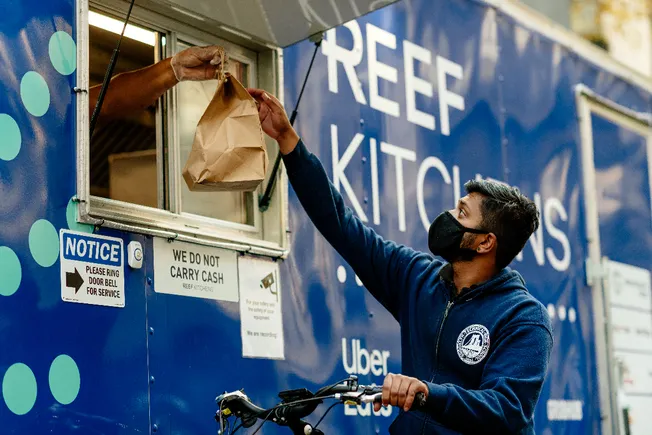
Reef Technology has become a leader in the rapidly growing ghost kitchen sector. However, in its home state of Florida, most of its mobile kitchens have violated health and safety regulations.
The problems are not limited to Florida. Regulators across the country are reviewing Reef's operations, leading to store closures in several of its largest markets—a pattern that has disrupted business and halted sales at some locations as Reef signs a series of major expansion agreements.
According to a Restaurant Dive investigation, of the 61 Reef kitchens inspected by the Florida Department of Business and Professional Regulation (DBPR) with valid or expired permits, 58 violated health and safety regulations. Florida's DBPR classifies violations based on their likelihood of causing foodborne illness: high-risk violations may directly cause illness, while medium-risk violations could cause illness in the future if unaddressed. Of these, 21 kitchens had high-risk safety violations—2 of which were forced to temporarily close—and another 23 had medium-risk violations.
These violations include: some locations lacked soap and running water at hand-washing sinks, and meat was stored at temperatures that were too high. Florida inspection records show, for example, that fish at one Reef location was "raw or undercooked" and had not "undergone proper parasite destruction treatment." Florida inspectors issued a stop-sale order for the fish on November 17, 2020.
Both locations forced to temporarily close were due to sewage leaking into the kitchen. On October 25, inspectors at one site "observed sewage overflowing from the three-compartment sink and flowing onto the mobile kitchen floor due to an overflowing wastewater tank." Another location was found with similar contamination on October 25, and its certified food manager failed to provide reports of employees diagnosed with foodborne illness.
Reef declined to comment on the closure of any of its locations due to health violations. The company's own Florida kitchen records also contradict state documents. A Reef spokesperson said Reef operates 43 kitchens in Florida, while Florida's permit and inspection records show at least 61 Reef kitchens as of November 1.
However, the spokesperson argued that the company's health and safety record is comparable to or better than other food service operators. Reef also stated that all employees receive appropriate training and certification before working in Reef kitchens. According to the DBPR, among Florida restaurant violations, slightly less than one-fifth are high-risk and slightly less than one-quarter are medium-risk.
But just this week, new reports of unsafe conditions at Reef kitchens emerged in other states. The Wall Street Journal reported Monday that Reef locations in Houston had delayed utility connections and propane explosion issues. Former Reef employees confirmed the Wall Street Journal's description of fireballs to Business Insider and said the company served undercooked food, and many locations lacked water for dishwashing and hand-washing. These details support the allegations revealed by Restaurant Dive's analysis of Florida public records.
Restaurant Dive also found evidence of similar misconduct at Reef's Chicago locations. Of the 12 Reef kitchens in Chicago, all had records of violations, with 6 failing direct inspections. Business Insider reported that these failed inspections led to store closures. Similar to Houston and Florida, hand-washing sinks lacked sufficient hot water, and refrigerated drawers were too warm. On one occasion, Chicago inspectors found a leaking wastewater tank; on another, a manager could not provide a food manager certificate.

Reef says its business model does not always fit regulations
In other cities, including New York City and Houston, Reef has been forced to close locations due to permitting issues, the company explained to Restaurant Dive. The company said it encountered permitting issues in New York City because its "containers" are neither food trucks nor brick-and-mortar stores, making them difficult to fit into existing permitting structures. However, the New York City Department of Health and Mental Hygiene told Business Insider that Reef violated other health and safety laws in the city.
Reef's growing number of violations reflects concerns about how to regulate the rapidly growing ghost kitchen market. Earlier this year, before Business Insider first reported on Reef closing kitchens in New York, Michael Beacham, President of Reef Kitchens and Retail, told Restaurant Dive that Reef's business model does not always fit existing regulations. But he emphasized that Reef works with local governments before opening locations.
"We go in early and sit down and say, 'Hey, this is what we plan to do,'" Beacham said. "We welcome scrutiny. So we ask them upfront, 'How do you want us to operate in locations you feel good about, and for those you're not satisfied with, what do we need to do to convince you that we will put public safety first?'"
Beacham claimed that Reef's proactive attempt to operate within local regulatory frameworks sets it apart from unnamed competitors' strategies. "Some companies go out and look for gray areas in the law," Beacham said. "Especially since this is a new industry, a new way of doing things... a lot of times regulations don't keep up with what we're doing."

Reef is still preparing for massive expansion
Despite these operational struggles, Reef's growth remains rapid. Between August and November 2021, Reef Kitchens announced agreements to open 2,300 ghost kitchens over at least the next five years, which would increase its number of locations fivefold. This rapid expansion has made Reef one of the largest ghost kitchen operators in the United States.
Reef is also the largest parking lot operator in North America, leveraging its parent company's real estate to strengthen its delivery kitchen network. Beacham said that with its existing parking business, Reef is uniquely positioned to access a substantial market. "Across the U.S. and Canada, we are within a five-minute drive of 70% of the urban population," Beacham said.
Beacham said Reef provides chains like Olive Garden and TGI Fridays with access to markets with high brand recognition but few locations; the latter recently signed a deal to open 300 Reef ghost kitchens. Peter Saleh, Managing Director and restaurant and food distribution analyst at BTIG, said the ghost kitchen model allows brands to enter expensive markets with relatively little capital. But he noted that smaller facilities like Reef's trailer-sized kitchens, which serve fewer brands, may be less attractive to customers than larger operations that can serve 10 or 20 brands.
"I think the real value is being able to mix and match on one order, giving customers the best options for desserts, sides, and all the major brands," Saleh said. But Saleh said Reef's model offers savings in capital, operational, and labor costs, which could appeal to brands of any size.
Beacham said the company's focus on dense markets gives it an advantage over competitors, especially since food quality deteriorates the longer delivery takes. "We place locations as close as possible to where people work and live," Beacham said. "We can deliver faster, cheaper, and better than anyone else."
According to Saleh, the size and limited channels of ghost kitchens may result in lower sales than traditional QSR locations. Wendy's has partnered with Reef, planning to open 700 ghost kitchens by 2025, and provided some expected sales estimates in a recent earnings call. "We expect per-unit sales between $500,000 and $1 million," Wendy's President and CEO Todd Penegor said on the second-quarter earnings call in August. According to Wendy's 2020 10-K filing, average annual sales per U.S. location were approximately $1,725,000, but international locations had lower sales, bringing the company's global AUV to about $1,654,700.
However, a Reef spokesperson said the company's best-performing locations generate sales comparable to brick-and-mortar stores. But the Wall Street Journal reported that daily costs at Reef kitchens exceed $1,800, while average kitchen revenue is about $1,250, which could be a problem for Reef, even if franchisees benefit from royalty fees. Nevertheless, Reef offers Wendy's access to urban markets and low capital costs, and the ghost kitchen platform will pay Wendy's above-average royalty rates, Penegor said on the second-quarter earnings call.
"Our royalty rates are higher, close to 6% in the U.S. and 5.5% in the UK. So even though sales at these [Reef] locations are slightly lower, we get good, healthy economics," Penegor said. According to Saleh, Wendy's franchise agreements typically have a 4% royalty rate. However, it is unclear how Reef shares other partner costs, such as national marketing expenditures, Saleh said.
Small and emerging brands are also betting heavily on Beacham's promise of top-tier speed at minimal cost. Nathan's Famous partnered with the company last year, and 800 Degrees Pizza, which has 16 locations, signed a deal with Reef to open 500 ghost kitchens in the U.S. and UK over the next five years. C3, a company focused on virtual brands and ghost kitchens, will launch its brands in 800 Reef kitchens.
Reef has also raised substantial capital. In 2019, Reef Technology raised $700 million for global expansion. The round was led by Softbank and Mubadala, a sovereign wealth fund linked to Mohammed bin Zayed, Crown Prince of Abu Dhabi and Deputy Supreme Commander of the UAE Armed Forces. In 2021, Reef acquired iKcon, a UAE-based ghost kitchen company.
So far, Reef's regulatory issues do not seem to have shaken investor or brand confidence in the company. Other tech-enabled service companies, such as Uber and Lyft, expanded significantly while flouting regulations. It was only after these companies established themselves that they pressured governments to change regulations to accommodate their business models. Years later, courts, regulators, and local authorities have begun to strictly limit the power of ride-hailing and delivery companies. Given that the ghost kitchen industry is still in its early stages, Reef, with its strong capital and powerful brand partnerships, has the potential to continue expanding without major regulatory issues.