
Chain brands race to optimize drive-thru: service speed becomes a key competitive dimension
This article is the second in a series, focusing on the challenges and strategies faced by chain restaurant brands as they expand their drive-thru channels. Hawaiian Bros has compressed its window service target to 30 seconds by adding dedicated service lines, dual-window division of labor, and outdoor ordering staff; Auntie Anne's and Jamba's co-branded drive-thru stores have improved order fulfillment speed by adding warming stations and window pickup racks; Taco Bell franchisee Diversified Restaurant Group has adopted a dual-lane separation design, reducing mobile order pickup time to under one minute; Schlotzsky's has launched two drive-thru prototype stores and continues to optimize signage and payment technology. Data shows that from February 2020 to February 2022, drive-thru order volume grew by 20%, highlighting the strategic importance of this channel.
This is the second article in this series, exploring how chain restaurant brands are addressing challenges through strategic adjustments as they expand their drive-thru channels.
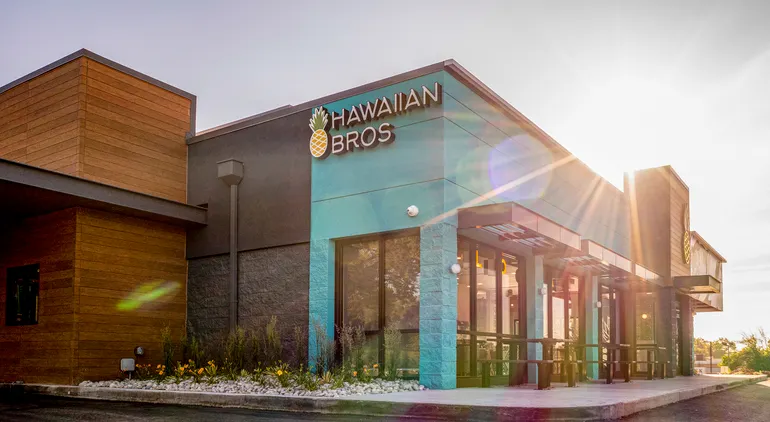
Shortly after Hawaiian Bros opened its third location in Overland Park, Kansas, co-founder Cameron McNie realized the drive-thru lane was causing serious problems. Although sales during the opening period were double those of the previous two locations without drive-thrus, the parking lot became congested.
"We had to seriously think about how to improve service. Not only to better serve the 30 cars currently in line, but also to consider potential customers driving by who see the congestion," McNie said.
Optimizing the drive-thru experience is crucial to the future of the business. Of Hawaiian Bros' 35 physical locations, only two do not have drive-thrus, but those two offer curbside pickup, so customers still don't have to leave their cars. McNie said that at locations with drive-thrus, drive-thru sales account for more than 50% of revenue. When combining delivery and curbside pickup, off-premise business accounts for 80% of Hawaiian Bros' total revenue.
To maximize the efficiency and sales potential of its off-premise business, the company redesigned its kitchens, adding a dedicated service line for drive-thru use. Hawaiian Bros also adjusted its drive-thru window process: beverages and Dole soft serve are now provided at the first window, while food is handed out through the second window.
The company also has some employees outside taking orders and payments from customers in line, and has set a target of 30 seconds for window service time. Depending on factors such as store size, foot traffic, and weather, typically 2 to 4 employees handle this type of order-taking.
Hawaiian Bros is not the only chain redesigning to improve drive-thru speed. According to The NPD Group, drive-thru orders grew 20% between February 2020 and February 2022.
Auntie Anne's opened its first co-branded drive-thru location with Jamba last year and continues to evaluate its operating model to optimize performance. Schlotzsky's has introduced two drive-thru-focused prototype locations and is exploring technologies that could reduce service times. Taco Bell franchisee Diversified Restaurant Group developed the Go Mobile store prototype, featuring dual drive-thru lanes to reduce mobile pickup times.

Cracking the drive-thru bottleneck
After Auntie Anne's and Jamba opened their first co-branded drive-thru location in Wylie, Texas, in 2021, teams from Auntie Anne's, Jamba, and their parent company Focus Brands traveled to the Atlanta headquarters to discuss operational performance and existing challenges. Auntie Anne's Chief Development Officer Alisa Gmelich said that meeting led to several design revisions, covering drive-thru layout, equipment, and fixtures, aimed at improving speed and ease of employee movement within the kitchen.
One of the biggest changes Auntie Anne's made was optimizing the pretzel warming station. Pretzels take 30 minutes to make and must be prepared in advance to meet customer demand. Initially, the warming station was located at the front of the store, requiring employees to retrieve pretzels and bring them to the drive-thru window. Gmelich said Auntie Anne's added a warming station next to the drive-thru window to speed up order fulfillment.
She added that the brand also added storage racks near the drive-thru window so employees can quickly access items like forks, napkins, and sauce packets to complete orders.
Auntie Anne's also evaluated the best location for the drive-thru window at future locations. Gmelich said that if the window is closer to the end of the building, it increases the space between when customers order and when they pay and pick up, giving employees more time to ensure orders are ready.
"We're looking to have street locations make up a larger share of our overall portfolio," Gmelich said. "We truly see the five-year vision for Auntie Anne's as: continuing to leverage our strengths as an impulse brand in malls, airports, entertainment venues, boardwalks, travel centers, and more, while also aggressively developing street locations with drive-thrus to make Auntie Anne's a destination for customers."

Developing store prototypes that improve speed
Other chains are turning to developing drive-thru prototypes that are not only easy to build but also improve service speed.
Taco Bell franchisee Diversified Restaurant Group opened its first Go Mobile location in Las Vegas in the summer. Taco Bell said in an email to Restaurant Dive that there are about 80 Go Mobile locations in its system.
Taco Bell's company-owned Go Mobile locations feature two drive-thru lanes: one for traditional window ordering and another for mobile order pickup, but during peak hours the two lanes merge into one line.
However, Diversified's Go Mobile locations keep the lanes separate throughout the process. Diversified Restaurant Group Co-Chief Operating Officer Todd Kelly said using two drive-thru lanes helps delivery drivers pick up orders faster and relieves pressure on the traditional drive-thru lane, since delivery orders are typically nearly twice the size of regular orders.
Kelly said Diversified's mobile order pickup time averages less than 1 minute, while traditional drive-thru fulfillment time is about 5 minutes. The company is using geofencing technology to trigger teams to prepare orders in advance, rather than relying on last-minute notifications through the drive-thru intercom. Kelly said Diversified is studying retrofits to add pickup windows in areas where a second lane cannot be added, and adding lanes where space allows.

Shelley Harris, Schlotzsky's former interim chief brand officer and now president of Focus Brands' restaurant category, said Schlotzsky's was evaluating how its drive-thru could meet consumer demand even before the pandemic.
Schlotzsky's has developed two prototype locations to improve the drive-thru experience. One is a 1,000-square-foot location with no indoor seating, offering dual drive-thru lanes and a pickup window; the other is a 1,800-square-foot location with a small dining area and dual drive-thru lanes.
While customers understand the dual drive-thru lanes intuitively, there is still some confusion about the "advanced order pickup window."
"Consumers are used to traditional drive-thru lanes, but when we introduce the 'advanced order pickup window,' there is definitely still confusion about the signage and which lane is for which type of pickup," Harris said.
At the Oklahoma City prototype, Schlotzsky's has begun redesigning the parking lot markings and planning what signage to place above each lane to help consumers better understand where to go.
Even with these new prototypes, Schlotzsky's still wants to improve drive-thru speed. According to company data, its system-wide average drive-thru service time exceeds 5 minutes, while the Oklahoma City prototype is slightly under 5 minutes. This could mean exploring ways for customers to pay at the menu board, but adding more technology requires evaluating its potential impact on labor and sales. Harris said it's important to first identify where the real bottleneck is before deciding what specific measures are needed to solve the drive-thru problem.
"I think this becomes even more critical when you start thinking about the technology side," Harris said. "You need to have two people who can take orders simultaneously, you need the right people on the production line to speed up order output, and payment technology is also part of it."
Correction:A previous version of this article misspelled Shelley Harris's name and misstated her title. She is currently president of Focus Brands' restaurant category.