
Four Growing Mediterranean Fast-Casual Brands in the Shadow of Cava
Cava's store count has grown 52% within two and a half years of its IPO, yet the Mediterranean fast-casual segment it dominates remains immature. This article examines the growth strategies of four brands—Taim, Taziki's Mediterranean Cafe, Nick The Greek, and The Halal Guys—from franchise expansion and regional focus to menu simplification—and how they address direct or indirect competition with Cava.
Cava has been a public company for less than two and a half years, and its store count has grown from 263 to over 400, an increase of 52%. Similar to Chipotle, Cava has leveraged its post-IPO capital advantages and strong unit economics to become the clear leader in the Mediterranean fast-casual segment. But unlike Chipotle, which has thousands of stores and over three decades of operations, Cava is still in the early stages of brand development, and the Mediterranean niche it leads is far from mature.
"Mediterranean dining will continue to grow, and I think these smaller players have an opportunity," said Mark Wasilefsky, head of TD Bank's restaurant franchise finance division. "Do regional brands have a chance to gain market share? Absolutely. But if you open a store and Cava opens on the same street, that's a real concern."
Wasilefsky noted that the diversity of Mediterranean cuisine, generational shifts in consumption, and consumer awareness of health benefits will drive continued expansion of this segment. Facing Cava's fully company-owned store network, smaller chain brands—from newcomers aiming for national expansion to established regional leaders—are trying various strategies, especially franchising, to compete. Here are observations on four of these brands.

Taim
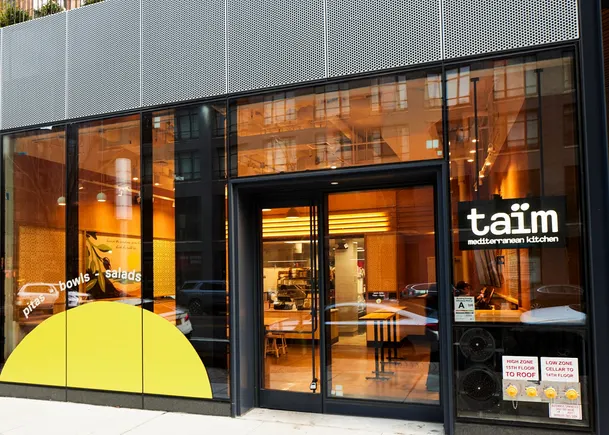
Taim Mediterranean Kitchen is one of the smaller players in this segment—when it launched its franchise program in July this year, the brand had only 14 locations. Gregg Majewski, founder and CEO of Craveworthy Brands, Taim's parent company, believes consumer demand for Mediterranean dining will only continue to grow.
"The Mediterranean diet gives you an advantage because everyone is learning about these foods and willing to try them," Majewski said. "It's a healthier lifestyle, and eating it several times a week has become very common."
Majewski said Craveworthy planned to franchise Taim when it acquired the brand in 2024. "We don't acquire brands we don't intend to franchise," he said. In Majewski's view, Taim differs from Cava in that its store model offers better return on investment while providing consumers with a more street-food-inspired experience. Once the brand is fully mature, franchising can leverage franchisees' local resources and capital for rapid expansion.
"When the franchise system is fully operational, I can open 50 to 100 restaurants a year without much effort," Majewski said. "I sell franchise territories much faster than they can open company-owned stores." He expects Taim and other franchise brands will eventually surpass Cava in store count. "I expect we'll surpass them at some point, and I expect several brands will surpass them," Majewski said.
But Taim hasn't reached that level yet, and Cava currently holds an overwhelming lead. In the Mexican fast-casual segment, Chipotle has consistently outperformed franchise competitors in scale and unit economics through its company-owned model, planning to open more than 300 new locations this year alone.
Taim's expansion strategy first focuses on areas where Cava already has a strong presence—core urban markets in the Mid-Atlantic, parts of the Northeast, and Illinois—with densely populated college towns also targeted. "I would never start in the Midwest suburbs," Majewski said. "I'd expand outward from those urban cores." This strategy puts Taim in direct competition with Cava on taste and store experience. The brand strives to offer superior food quality—though most restaurants claim their products are better. "In a matchup between Cava and us, I'd put my falafel up against any of theirs," Majewski said. He emphasized that Taim highlights Israeli flavors rather than a generic blend of Mediterranean ingredients. However, these differences often manifest in spices and cooking techniques that end consumers may not immediately notice.

Taziki's Mediterranean Cafe
Taziki's is one of Cava's strongest competitors, with over 100 locations. According to its franchise disclosure document, average unit volumes (AUV) for franchised stores exceed $1.9 million, while company-owned stores reach $2.3 million. A TD Cowen research brief from April this year shows the brand is the second-largest player in the Mediterranean fast-casual segment.
CEO Dan Simpson said the segment's success stems from the convergence of two consumer trends: baby boomers increasingly focused on diet, nutrition, and longevity, and younger generations pursuing balanced, sustainable lifestyles. Simpson said brands that capture these trends benefit from a self-reinforcing effect of cultural visibility.
In Simpson's view, the competition isn't within the Mediterranean segment, but rather between this segment and other fast-casual categories. He joked that Mediterranean brands could pool their marketing budgets and launch a joint national campaign to promote the cuisine. "Let's go compete with Panera, Chipotle, and all the other brands—because even if you add all of us together, [Mediterranean dining] is still a very small percentage of all restaurants, even within fast casual," Simpson said. "This is far from the ceiling and far from full potential."
Taziki's, concentrated in the southeastern U.S., positions itself as a brand that "adapts Mediterranean flavors to American tastes." Simpson points to the brand name as an example—it's a shortened form of Tzatziki (the Greek yogurt-cucumber sauce). This localization effort also includes expanding the menu beyond the narrow, well-known Greek dishes like pita wraps and spanakopita. Taziki's aims to cover more consumption occasions with a broader menu. "We have various salads and are always trying different salad options, various grilled proteins, obviously cooked with olive oil, paired with a glass of wine—that's part of our elevated experience—and finishing with dessert. There's a lot you can do within this flavor framework," Simpson said.
Taziki's emphasis on experience begins before customers even enter: outdoor patios with lighting and planters full of olive trees—interior design is equally focused on customer comfort. "All of that combined feels more like a casual dining setting," Simpson said. "It's far removed from the fast-food experience." Taziki's is currently about 40% company-owned and 60% franchised, and doesn't pursue rapid store count growth—instead focusing on densifying existing Southeastern markets and expanding into adjacent Midwestern and Southern markets. Its primary franchising principle is finding the right partner in the right location. "We need local operating partners," Simpson said. "That's often why franchising works—they're often from the area, deeply rooted there, and that's what makes it effective."


Nick The Greek
Unlike Taziki's, which Americanizes its brand and broadens its menu for approachability, Nick the Greek has chosen to Americanize and simplify its menu, John Ramsay, head of franchising at parent company Yadav Enterprises, told Restaurant Dive. The brand, originating in San Jose, California, with about 90 locations, limits its protein options to three rotisserie meats—beef, chicken, and lamb—and two skewers: grilled chicken and grilled beef. The menu is built around this streamlined core, with proteins served in pita sandwiches, rice bowls, salads, or on platters. Ramsay said this creates a relatively simple operational flow for operators.
Ramsay said that, similar to Taziki's, Nick the Greek views larger fast-casual chains—Panera, Chipotle, Raising Cane's—as direct competitors rather than other Mediterranean fast-casual brands. Anil Yadav is a large Jack in the Box franchisee and owns both Nick the Greek and Taco Cabana, meaning the brand shares the same finance, legal, and supply chain teams. This structure creates significant efficiency advantages, making franchise expansion smoother.
Nick the Greek is currently concentrated in California, which remains its expansion target. While other competitors eye national expansion, Nick the Greek plans to build fortress markets outside California: Phoenix, Las Vegas, Reno, Nevada, and several areas in Texas and Tennessee. "We won't go to New York or Florida immediately, but will prioritize entering markets we're already in and going deeper," Ramsay said. This strategy helps the brand solidify its store base and avoid direct competition with Cava—which recently named the Midwest and Florida as growth markets. Ramsay said this strategy could help Nick the Greek reach 400 locations within five years, provided the right franchisees are found. "Local market experience is an extremely important element," Ramsay said. "We almost always start with people who have experience and have successfully operated restaurants in the area." With franchise agreements lasting up to 20 years, finding operators who can nurture the brand long-term—rather than stopping at one or two stores—is crucial.


The Halal Guys
The Halal Guys is a brand that has deeply experienced the importance of franchisees. According to its franchise disclosure document, 8 of the brand's 88 franchised locations closed in 2024. CEO Ahmed Abouelenein said these closures were necessary to remove operators who didn't meet brand standards from the system. "This has a positive impact on other franchisees because the brand's reputation isn't damaged by that location," Abouelenein said.
Similar to Nick the Greek, The Halal Guys' menu is extremely streamlined, featuring only four core items: chicken, gyro meat, rice, and falafel. This stems from the brand's origins as a New York City street cart—where space and efficiency were extremely scarce resources. "This makes training easy," Abouelenein said. "If training is executed well, output is very consistent."
Currently, The Halal Guys focuses on controlling restaurant quality and protecting the brand. "We don't want the brand expanding everywhere without food quality control, because food is the soul of the brand. If food quality suffers, growth is meaningless," Abouelenein said. But the growth of Mediterranean dining demand in the U.S. and other countries gives The Halal Guys confidence in its model. Abouelenein expects the brand will sell enough franchise rights within several years to reach 300 to 400 locations. He said U.S. growth will come from a geographic mix: the brand will continue deepening its presence in the 21 states and Washington, D.C. (according to its FDD) where it already operates, while also targeting new market entries to introduce the brand to new consumers. Abouelenein expects rapid expansion to become a dominant theme among many Mediterranean fast-casual brands.