
California Fast Food Labor Law Referendum Battle: The Survival and Impact of the FAST Recovery Act
The coalition opposing the Fast Food Recovery Act reached a key milestone on December 5, collecting enough signatures to trigger a statewide referendum, suspending the act until the 2024 general election. The act proposes establishing a labor council for fast food chains with over 100 stores nationwide. Supporters call it a historic labor rights reform, while opponents worry that a $22 minimum wage will disrupt business models. Experts say the act's actual impact remains unclear, with both sides deeply divided over wages, menu prices, and worker rights.
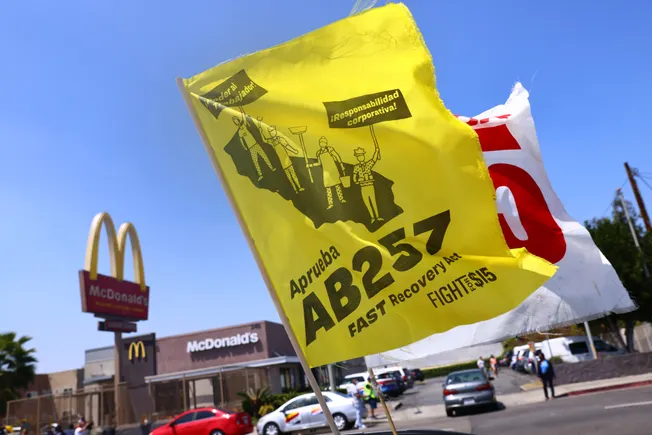
Opponents of California's landmark labor reform bill, the Fast Food Accountability and Standards Recovery Act (FAST Recovery Act), reached a significant milestone on December 5. A coalition backed by several major U.S. restaurant companies collected enough signatures to trigger a statewide referendum—putting the law on hold until the 2024 California general election.
The referendum has plunged national fast-food chains and the law's supporters, including the Service Employees International Union, into a protracted political battle. However, the 23-month suspension offers a brief respite for restaurants worried about the law's impact on their operations, yet operators' anxiety remains high.
The law proposes establishing a council for fast-food chains with more than 100 locations nationwide to regulate their wages and working conditions. Supporters call it a pro-labor, once-in-a-generation change to labor law; opponents claim the council could set a $22 minimum wage, which would threaten the basic fast-food business model.
California's minimum wage will reach $15.50 per hour for employers on January 1, 2023. An hourly wage of $22 would be about 42% higher than this new wage floor. According to data from the University of California, Berkeley Labor Center, some California cities have their own minimum wage standards. Among them, Emeryville has the highest minimum wage in the state, with workers earning at least $17.68 per hour.
Federal data shows that most restaurant workers nationwide already earn more than California's minimum wage, with average hourly earnings of about $17.24 in October. An hourly wage of $22 would be 27% higher than this national average.
Notably, some large fast-food chains opposing the law are already offering starting pay close to the $22 minimum wage the FAST Recovery Act might allow. According to Glassdoor data, In-N-Out, which has spent $2.5 million opposing the law, is hiring part-time store employees in California at a range of $15 to $23.50 per hour. A similar search for Chipotle, another major opponent, shows the Mexican-style fast-food brand is currently hiring workers at between $15.50 and $20.33 per hour.
Despite the fierce support and opposition surrounding the issue, experts say it remains unclear how the law would actually affect restaurant workers and business owners.
"We don't know exactly what this council would do in terms of raising labor costs," said Christopher Thornberg, director of the Center for Economic Forecasting and Development at the UC Riverside School of Business. "The initial regulations cap the council's ability to raise the fast-food minimum wage at $22 an hour... so we could be talking about a huge increase."

Wage increases will push up menu prices—but by how much?
The core argument of "Save Local Restaurants" (SLR), the industry group funding the 2024 referendum to repeal the FAST Recovery Act, revolves around profits. SLR argues that a fast-food council empowered to raise fast-food hourly wages to $22 would prompt operators to pass those costs on to customers. SLR claims this would lead to lower sales and prompt some restaurants to close locations and lay off workers—a lose-lose situation for operators and employees alike. However, Thornberg says it is unclear what wage level the council would set.
In contrast, supporters of the FAST Recovery Act say the cost increase would be small, pointing to research showing that geographically limited minimum wage increases do push up the cost of eating out, but wage increases also tend to lead to increased consumer spending.
According to a study by experts at MIT and the Federal Reserve Bank of Boston, a 10% increase in the minimum wage typically leads to a 0.5% rise in inflation in the eating-out sector. This peer-reviewed analysis, published in the Journal of Money, Credit and Banking, suggests that as the minimum wage rises, spending on eating out increases because lower-income consumers tend to spend more on dining out when their disposable income grows. However, the analysis focuses on the impact of across-the-board wage increases, not targeted wage hikes in a specific industry.
A report Thornberg wrote at the request of the International Franchise Association estimates that a roughly 50% surge in restaurant labor costs could lead to an approximately 18% increase in consumer costs, as businesses protect profit margins by passing on increased costs to diners.
But David Madland, senior fellow at the Center for American Progress's American Worker Project and a major advocate for labor reform, says wage increases in the restaurant industry do not translate linearly into menu price increases.
"(When wages rise) employee turnover decreases. The fast-food industry has extremely high turnover, exceeding 100% annually. And the cost of constantly recruiting and training new employees is quite high," Madland said.
Input cost pressures can prompt businesses to operate more efficiently. Madland says data shows menu price increases often follow wage increases in the restaurant industry, but he says such price increases are typically relatively modest.
Thornberg and Madland disagree with each other on the FAST Recovery Act.
Thornberg says economists who support the law are out of touch with business reality. "They live in a magical, mystical world where you can raise one of the biggest input costs in the fast-food industry," he said. "You can raise (labor costs)—in their view by 30% to 40%—and have almost no impact on food costs. That's bizarre."
Madland, in turn, asserts that those opposing the law rely on poor data to make doomsday arguments. "Those numbers are fabricated. Their claim that this would cause extremely high inflation is completely over the line, absurd, and should be refuted."

Workers say there are problems. Businesses disagree.
For years, California fast-food workers have been fighting for higher pay. The "Fight for $15 and a Union" movement, led primarily by fast-food workers, successfully pushed the state to raise the minimum wage starting in 2016. Workers have used strikes, public demonstrations, and political campaigns as tools. For activists, the FAST Recovery Act is a path to changing working conditions and pay through direct negotiation with the state government and the industry. Supporters also argue that the fast-food council would give workers more political power to address wage theft and sexual harassment.
Ingrid Villorio, a fast-food worker at Jack in the Box in California, says she was a victim of wage theft. In a phone interview assisted by an interpreter, Villorio, a native Spanish speaker, told Restaurant Dive that her employer withheld more than $4,000 from her and violated sick leave regulations. Villorio filed a complaint with the state labor commissioner, spent over a year trying to recover the back pay, but ultimately received only $1,500 from her employer.
Villorio claims that low pay and other problems are widespread in the fast-food industry. "I have experienced wage theft, racism, (violence from management), and all of us have encountered at least one of these problems at work," she said. Villorio hopes the FAST Recovery Act takes effect and that the council strengthens enforcement of regulations on restaurant wages, working conditions, and sexual harassment.
A pre-pandemic analysis by the Harvard Business Review found that up to 90% of women and 70% of men working in the restaurant industry have experienced sexual harassment. An April 2022 report by the worker advocacy group One Fair Wage found that a majority of women working in restaurants (73%) frequently experience sexual harassment or witness inappropriate sexual behavior from customers. OFW says the pandemic has made customer harassment more prevalent. A survey conducted by the Fight for $15 and a Union in support of the FAST Recovery Act estimates that wage theft is widespread in the industry, with 85% of surveyed restaurant workers having experienced wage theft.
Despite such reports, restaurant industry representatives and economists opposing the FAST Recovery Act say establishing a fast-food labor council is unnecessary—it's a solution in search of a problem.
"Workers have choices now. If they don't want to work in a restaurant, if they want to earn more money, they can find many jobs, many industries, that are currently experiencing the same labor shortages," said Sean Kennedy, executive vice president of public affairs at the National Restaurant Association. The NRA has spent more than $400,000 to defeat the law at the ballot box.
Faced with industry problems, many restaurant workers have chosen to leave, moving to new employers or new industries. Between June and October—the most recent months for which national labor turnover data is available—more than 25,000 restaurant workers quit each day, with a total of 3.901 million resignations over the five-month period. This exodus has kept the restaurant industry facing labor shortages, giving workers more flexibility in choosing their employers.
The results of this flexibility are statistically evident. The COVID-19 pandemic drove nearly 6 million workers out of the industry in two months. But restaurant industry employment did not sustainably surpass 10 million again until February 2021—the same month industry wages exceeded pre-pandemic levels. Since then, wages have risen steadily along with employment levels.
Jennifer Sherer, senior state policy coordinator at the Economic Policy Institute, a think tank focused on progressive economic policy, says the status of fast-food jobs is not fixed, because workers' wages and their position in the economy are determined by political factors.
"There's an outdated notion that there's some natural market that sets fair wages," Sherer said. "Employers deliberately seek ways to boost profits by suppressing wages, and policy choices have enabled and to some extent condoned this wage suppression."
Thornberg says market forces driven by restaurant labor shortages have made restaurant jobs better. He also asserts that fast-food jobs are not, and should not be, high-paying jobs.
"To be clear, these are entry-level positions. They are not designed to be careers. This is something someone does as a side job, to earn some extra money, or to gain a bit of work experience," Thornberg said. "That's not how the world works."
Villorio says many people don't understand what it's like to work in fast food. "If you want to know what it feels like to be a fast-food worker, I invite people to come work in this industry for a day. They would understand what we're talking about."

California's governor would appoint most members of the fast-food council
Although the fate of the FAST Recovery Act depends on the 2024 referendum, if the law survives the challenge, Governor Gavin Newsom would have considerable influence over the composition of the fast-food council. Newsom would appoint representatives of his administration, employees, franchisees, and franchisors—8 of the council's 10 seats. The Speaker of the California Assembly, in consultation with the Senate Rules Committee, would appoint the final two seats: worker advocate representatives.
Until then, rhetoric from both sides on the issue is likely to remain contentious. Supporters and opponents of the FAST Recovery Act each accuse the other of taking actions hostile to democracy. Opponents call the fast-food council a committee of unaccountable bureaucrats. Supporters say the industry is using California's referendum process to repeal a law that gives workers more power.
"They are trampling on democracy," Villorio said of the FAST Recovery Act's opponents. "We keep restaurants running 24/7, 365 days a year, and this industry is working against its own workers."
Villorio says that if the referendum fails and the council takes power at the end of 2024, she believes workers and franchisees can work well together. "We want franchisees to sit at the same negotiating table with us," she said.
In previous Restaurant Dive reporting, California franchisees said they are skeptical of workers' efforts to take control of the restaurant industry, because workers have not directly invested in the success of the franchise.
Beyond the ideological conflict over the FAST Recovery Act, there are widespread concerns about the functioning of California's referendum process.
Veronica Carrizales, vice president of policy and external affairs at California Calls, an organization dedicated to mobilizing low-propensity voters, says the state's referendum process is no longer working as intended.
"California's referendum process is broken and in urgent need of reform," Carrizales said during a December 5 press call hosted by SEIU and the Fight for $15 and a Union. "Powerful corporations have co-opted what was meant to be a tool of direct democracy in this state into a tool to trample on workers' rights."
However, Kennedy says the restaurant industry felt it had no choice but the ballot box. "This is really California tilting toward labor in an unfair way," he said. "This is an unelected council—it's not even legislators doing this. It's not even the state wage board doing this."
Thornberg says the FAST Recovery Act's council shifts responsibility for labor law to California's executive branch.
"This functionally usurps the balance of power that the Greeks envisioned when they came up with this system," Thornberg said. "They envisioned that you just strip it completely out of the legislative process and the economic process."