
Boston Coffee Industry May Move Toward Industry-Wide Unionization
Six years after workers at Gimme Coffee in Ithaca, New York, won a union victory, thousands of workers at hundreds of coffee shops across the country have formed unions. The union victories at coffee shops in the Boston area may best foreshadow the future of organized coffee shop labor. UNITE HERE has organized multiple coffee chains in Boston and its nearby suburbs and is driving industry standard improvements through a foundational contract model.
Six years after workers at Gimme Coffee in Ithaca, New York, won a union victory, thousands of workers at hundreds of coffee shops across the country have unionized. However, the union victories at Boston-area coffee shops may best foreshadow the future of organized coffee labor.
In Boston and its inner suburbs, UNITE HERE has organized several coffee chains.
Compared to coffee shops in upstate New York represented by Workers United, or those in the upper Midwest and Illinois represented by the IBEW, UNITE HERE represents a smaller number of coffee shops in Boston. But according to Annina Kennedy-Yoon, business manager of the union's New England Joint Board, UNITE HERE coffee shops in Boston are developing a base contract to serve as a model for other organizing efforts. These efforts could ultimately have the power to transform the city's coffee industry.
The base contract model
On August 5, 2022, workers at Pavement Coffee, represented by UNITE HERE, voted to approve a contract. According to Kennedy-Yoon, UNITE HERE's bargaining committee has since used that contract as the basis for negotiations.
"We want to raise the floor of the industry," Kennedy-Yoon said. "People think barista work is unsustainable, not a career option. We're trying to change that perception little by little."
This strategy shows that Boston workers are building a coherent and geographically concentrated organizing base. Local momentum could be a precursor to the kind of industry-wide organizing UNITE HERE has achieved in Las Vegas and other major hospitality markets—where unions have improved working conditions and accumulated significant political power.
Kennedy-Yoon, who first joined the union as a barista at Darwin's, said that UNITE HERE contracts may not be perfect but represent a starting point that subsequent negotiations can improve upon. Training, scheduling, and paid time off have become specific demands in UNITE HERE's Boston coffee shop organizing efforts. In addition to these benefits, baristas in Boston are also fighting for contracts that include "just cause" discipline clauses, which clearly define consequences for work violations and regulate disciplinary procedures.
"So if you're late once, you can't just get a final warning," Kennedy-Yoon said of the standard.
Just cause protections are a standard issue in union contracts, but workers at shops like Diesel, Bloc and Forge, 1369, and Pavement are pushing for more inclusive anti-discrimination protections. These goals include provisions against discrimination based on housing status and gender identity.
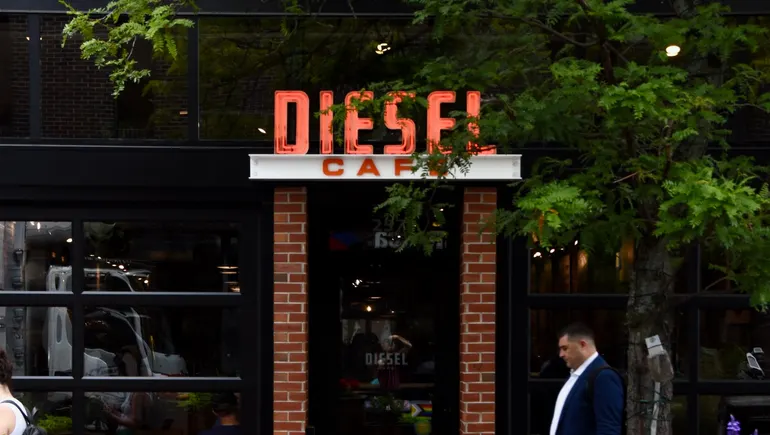
Chris Duncan, a bargaining committee member and shift supervisor at Diesel coffee shop in Somerville, Massachusetts, and his colleagues voted to approve contracts for Diesel and its two sister businesses, Bloc and Forge, earlier this year. The contracts, modeled on those at other UNITE HERE-represented coffee shops, are among the first in the industry explicitly aimed at unifying working conditions across unionized coffee shops.
"We wanted a disciplinary system that applies consistently to everyone," Duncan said.
The new process outlined in the contract is a series of clearly defined progressive discipline steps. Duncan said Diesel, Bloc, and Forge had disciplinary procedures before the contract, but policies largely depended on management discretion, and workers were sometimes fired for offenses that should have been first written warnings. These changes have inspired other workers to organize.
Eoin Jaquith, a barista at 1369, said UNITE HERE's New England Joint Board organizing efforts ultimately inspired workers at 1369 to organize. 1369 operates two coffee shops, one in Central Square in Cambridge and another in Inman Square on the border of Somerville and Cambridge.
Jaquith said the union movement is a way to provide workers with security and regulate working conditions. This standardization could include changes within the workplace, such as uniform pay scales for all new employees or clearly delineated disciplinary processes. As union density increases, forcing employers to compete with each other in providing safe and consistent working conditions, this standardization could also extend across multiple brands.
"In many small coffee shops, there are always issues that get overlooked," Jaquith said. Unions enable workers to demand consistent pay scales, sick leave accrual plans, COVID-19 policies, and other changes in working conditions.
Pay is also an ongoing concern for workers organized with UNITE HERE. Duncan said the contracts at Diesel, Bloc, and Forge include a starting wage increase of $0.95 per hour, with workers receiving raises twice a year, plus tips. He said café employees successfully pushed employers to raise suggested tip amounts on POS machines from 10%, 12%, and 15% to 15%, 18%, and 20%.
While wages are a driving factor in many campaigns, workers also want safer workplaces and more say in operations.
For Jaquith, safety issues are a significant factor. At 1369, Jaquith said the stairs between the kitchen and the basement where goods are stored are unsafe. During the union campaign, the most contentious discussions between workers and management involved these stairs, which often become slippery from condensation dripping from the HVAC system. Jaquith said that after the election, 1369 installed handrails, but only after a union representative visited the store to emphasize workers' demands.
"I worked with a colleague who fell on the stairs and definitely got a concussion, but definitely didn't get medical treatment. I've fallen myself, just didn't get hurt," Jaquith said.
Insurance-related health and safety issues may also make workers at small coffee shops more inclined to organize. According to the National Federation of Independent Business, because small businesses like coffee shops lack the purchasing power of large employers, they often cannot provide high-quality health insurance.
"The end result is that people go for long periods without seeing a doctor for various aches and pains caused by work," Jaquith said.
Kennedy-Yoon said this situation can make organizing more attractive to workers because unions like UNITE HERE's New England Joint Board negotiate for health insurance, dental, and other benefits.
Owners of Diesel, Bloc and Forge, Pavement, and 1369 did not respond to requests for comment.

Why Boston?
Rising living costs and rents may push workers to make more demands of employers, especially in jobs where neighborhood ties matter.
"All the coffee shops are in very trendy, up-and-coming areas, because that's how coffee shops make money. But none of us can afford to live there unless we have another job," Jaquith said. According to Rent.com, average rents in Somerville, where 1369 is located, range from about $2,145 for a studio to $3,499 for a two-bedroom, making housing difficult for individual workers to afford.
Over the past year, other industries in the Boston area have also faced union organizing campaigns due to rising living costs, from residents at Mass General Brigham to graduate students at Boston University to undergraduate resident assistants at Tufts University.
Boston, as well as Somerville and Cambridge—two small cities across the Charles River from downtown Boston—has a large student population. Massachusetts has a higher union density than the national average.
In the year and a half before the COVID-19 pandemic, the Boston area saw two major private-sector strikes—one organized by UNITE HERE at Marriott hotels in 2018 and another by the UFCW at Stop & Shop in spring 2019. The Boston area is also politically further left than some other cities. Somerville elected two socialists to its city council in 2021 and re-elected two candidates backed by socialist organizations. Progressive Democrat Michelle Wu won the Boston mayoral election that year.
Kennedy-Yoon said the recent wave of coffee shop organizing has united baristas in the Boston area, with organizers from one shop helping other workers. In some ways, she said, the industry's high turnover rate can benefit organizers because workers with union organizing experience move to other jobs. Kennedy-Yoon said a member of the organizing committee in the Darwin's campaign had organized at Pavement.
"You might not work at one place for five or six years, but once you have the experience, know how to pull espresso shots or steam milk, a lot of times workers move around," Kennedy-Yoon said. "That really helps with organizing."
The end goal
For worker organizers like Jaquith and union staff like Kennedy-Yoon, the ultimate goal of organizing is to change the coffee industry.
Kennedy-Yoon said that as coffee shops in Boston ratify contracts, workers will be more likely to organize at other coffee shops, and owners of other coffee shops will be forced to raise wages and benefits to compete for workers.
"It comes back to taking a stand on benefits like paid time off, better healthcare, and sick leave," Kennedy-Yoon said. "The more coffee shops we can get to offer these benefits, the easier it is to say, 'Yes, this is the industry standard.'"
Labor-management committees are a component of UNITE HERE's base contracts and a demand of Starbucks Workers United, and Kennedy-Yoon said they are another element of change. Such committees give workers a more direct voice on workplace issues, though Kennedy-Yoon said they also help streamline operations because workers often identify weaknesses in processes and suggest improvements.
UNITE HERE achieved voluntary recognition at Diesel, Bloc and Forge, Pavement, and Darwin's through card check agreements. UNITE HERE has used card check recognition and industry standard contracts in Nevada to raise wages and benefits. This strategy has built one of the largest and most politically influential local labor organizations in the country: UNITE HERE Local 226.
Jaquith hopes small coffee shops can become workplaces where wages are sufficient to support long-term careers. According to Jaquith, former employees of 1369 from the early 2000s told him they were able to work there and raise children and support themselves. But Jaquith said the costs of housing, healthcare, and other goods make this impossible at current wage levels.
"You can't work at a coffee shop and afford to raise a kid. It's ridiculous now. But in the past, people did build their lives around it," Jaquith said. "I want to be able to—I want my coworkers and the industry to be able to (if they decide to) build lives around coffee shop work."